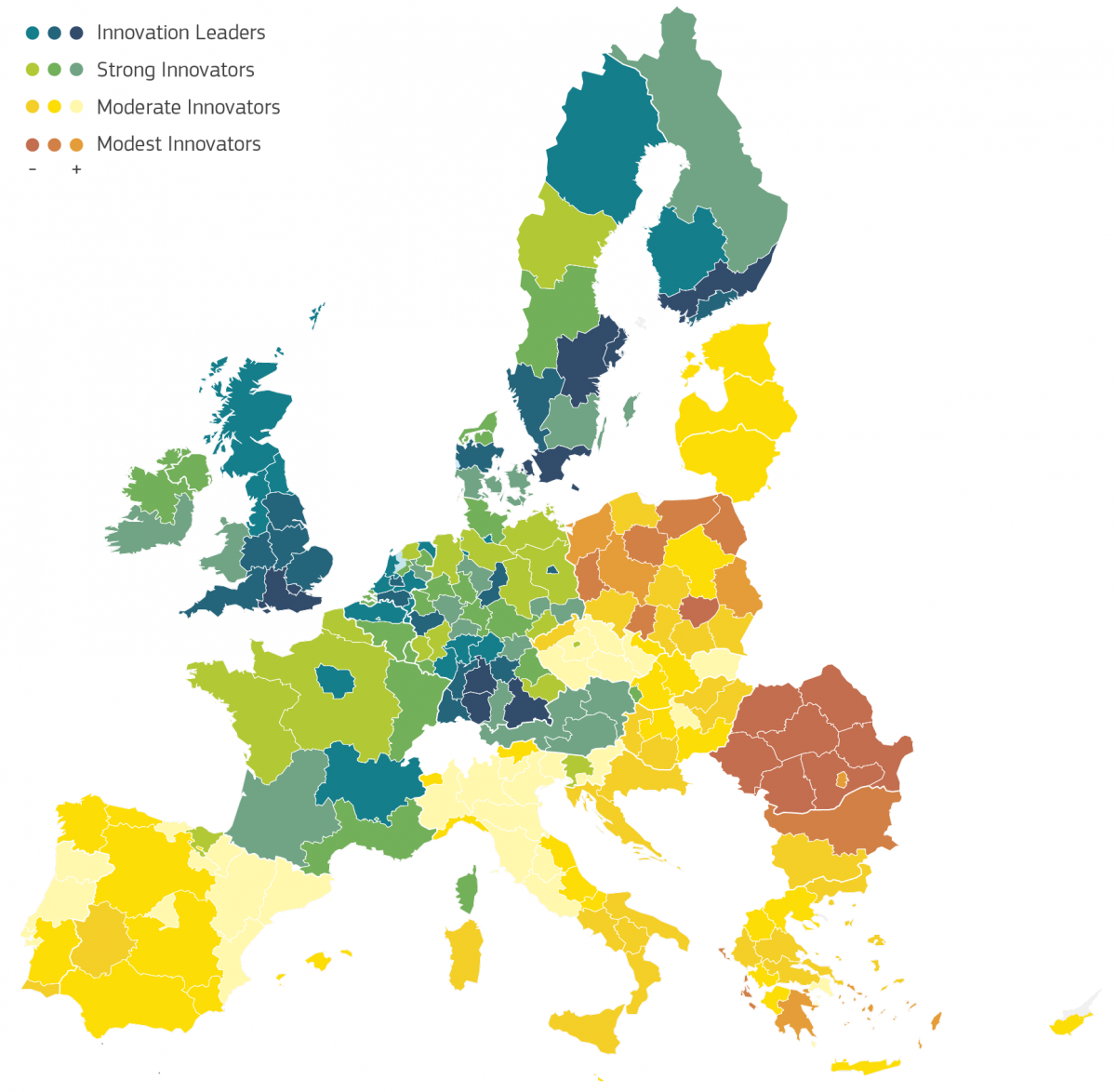
Basque Fact of the Week: Euskadi is a “Strong Innovator”

Historically, the Basque Country’s economy has focused on agrarian and industrial activities, the later mostly centered on steel and shipbuilding. However, the government of Euskadi — or the Basque Autonomous Community comprised of Bizkaia, Gipuzkoa and Araba — has invested heavily on modernization, with significant expenditures on research and development, particularly by business — of all Autonomous Communities in Spain, Euskadi invests the greatest percentage of its gross domestic product into R&D. The Basque Country has the highest per capita income in Spain and is one of the regions of Europe with the highest numbers of tertiary, or post-high school, degrees. Its success is based on the decision to invest in industry, not tourism.

Image from the European Commission.
  • Euskadi is growing in scientific leadership. According to Ikerbasque, the Basque Foundation for Science, Euskadi published more than 6000 scientific papers in 2017, a 50% increase over the last 6 years. This is 6.5% of the total scientific productivity of Spain, when Euskadi has 4.7% of the population.
  • Science investment in Euskadi is driven by the so-called Plan de Ciencia, Tecnología e Innovación Euskadi 2020. This plan emphasizes three strategic priorities — energy, advanced manufacturing, and bio-sciences and health — along with four areas of opportunity — agri-food industry; territorial planning and urban regeneration; leisure, entertainment, and culture; and ecosystems.
  • One feature of the Basque commitment to scientific R&D is their network of Cooperative Research Centers. Centers focused on Biomaterials, Biosciences, Energy, and Nanoscience are spread throughout Euskadi. These centers were created by the Basque Government to “create an effective framework of cooperation in strategic research areas, strengthen interdisciplinary basic and applied worldclass research in those areas and provide technology transfer to the industrial environment” (from the NanoGUNE website). 
  • Not everything is smelling like roses. Euskadi’s rankings have fallen over the last year. This is maybe reflected by the drop in R&D expenditures in recent years. Drops in government investment were at least partially offset by increases in private spending. And Euskadi is relatively weak in non-R&D innovation and patent applications.

Basque Fact of the Week: Basques and Chocolate

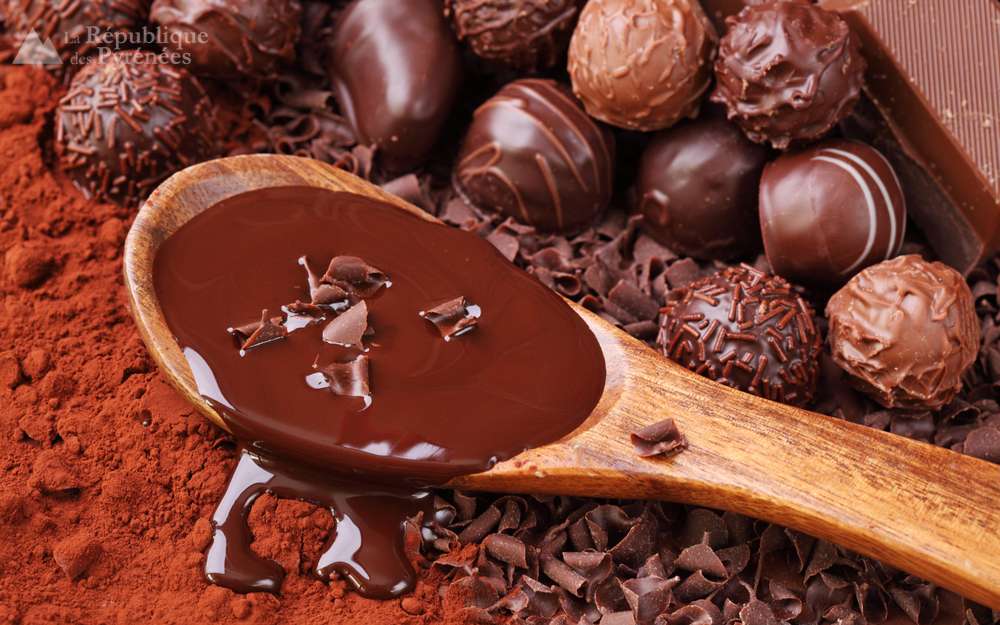
As in many places, chocolate is a big part of Basque life. On birthdays, instead of the birthday cake familiar in the United States, Basques often drink a cup of liquid chocolate. It wasn’t so long ago, in the early 1800s, that chocolate was a common part of breakfast in the Basque Country. It was often viewed, not as a treat, but as a health drink, inspired, in part, by the way the Mayans and Aztecs used it as, effectively, an energy drink. Indeed, Hernán Cortés noted how drinking cocoa could help one resist fatigue. But, the Basques were also a big part of the development and commercialization of chocolate.

Image from Cruise Europe.
  • Europeans first encountered cocoa during the conquests of the “New World.” The first reference to cocoa was in 1502, when Christopher Columbus encountered the Mayans. It wasn’t long, in 1520, before the Spanish brought cocoa back to the Iberian peninsula, where they made chocolate by adding sugar to the cocoa. The Spanish guarded their secrets carefully and it wasn’t until 1600 that first Italy and then France learned how to make chocolate.
  • Baiona became an important center for making chocolate when the Jews that were expelled from Spain by the Catholic Kings. By 1670, the city was giving chocolate as a gift to visitors. In 1761, the statutes of the chocolatiers of Baiona were passed, saying that one had to be a Master to open a chocolate shop in the town. At the same time, though, the Jews that had originally brought the art of making chocolate to the city were banned from selling it outside their own district. By the end of the 18th century, half of the chocolate consumed in France was produced in Iparralde, or the French Basque Country. There is an annual festival in Baiona celebrating chocolate!
  • On the Spanish side, in 1728, the Real Compañía Guipuzcoana de Caracas was created to encourage trade between Spain and the Indies, at least in part as a reaction against Dutch trade with the Spanish colonies and the inability of the Spanish crown to control that trade — they wanted to break the Dutch monopoly on cocoa. This company enjoyed two special privileges, given by royal decree: a monopoly on the commercialization of cacao and the ability to persecute illegal trade. It wasn’t until 1774, again due to royal decree, that trade opened up between other countries of Europe and cacao producers in South America. This led to the first chocolate factory, founded in 1776, in France. The company dissolved in 1785. The company had a large role in the politics of Venezuela, including border expeditions such as that led by a company man, José de Iturriaga y Aguirre.
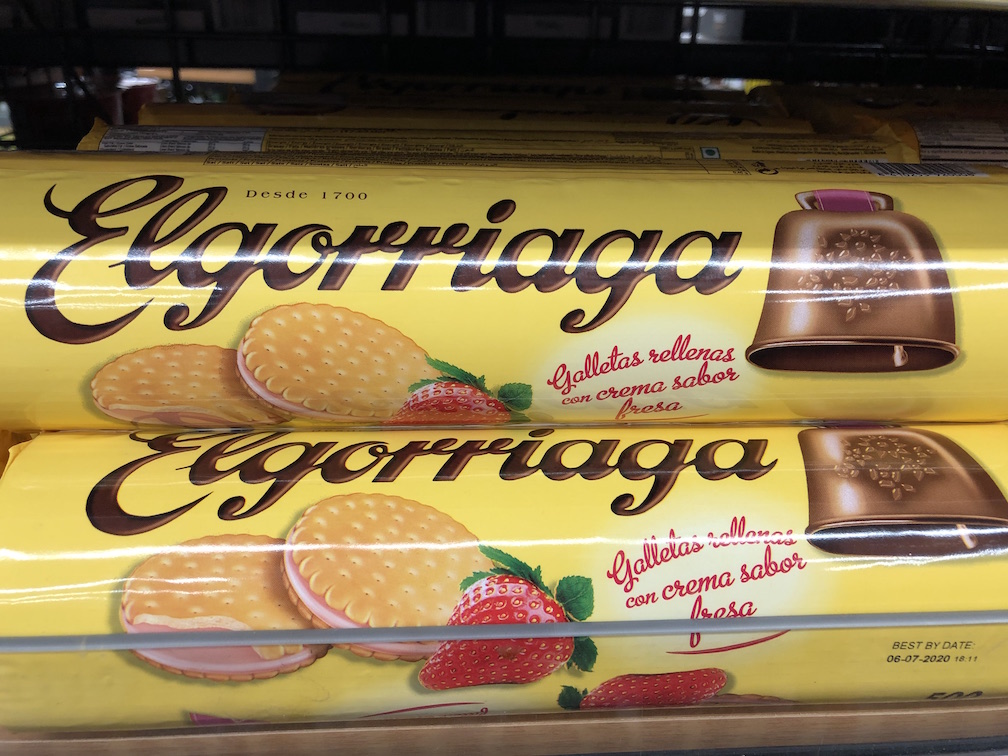
  • The chocolate company Elgorriaga was founded in 1770. It arose from shepherds going to market in Irún, Gipuzkoa. Some of the shepherds opened a chocolate business. In the 19th century, the wife of one of the shepherds opened a shop, calling it Confitería Elgorriaga, after the family. Today, the company is now part of the larger Urbasa Global Brands. While not its own company any more, Elgorriaga chocolates can be found the world-over.

Primary Source: Aguirre Sorondo, Antxon. Chocolate. Enciclopedia Auñamendi, 2019. Available at: http://aunamendi.eusko-ikaskuntza.eus/es/chocolate/ar-36174/

Basque Fact of the Week: Earliest Written Evidence of Euskara

Euskara, the language spoken by the Basque people, is now spoken by about 750,000 people. The language is perhaps the most singularly important feature identifying the Basque people. Indeed, the word for a Basque person in Euskara — euskaldun — means ‘one who has Euskara.’ Thus, the history of the language itself is of great interest and importance in understanding the history of the Basque people. Given that Basque has not had a strong written history, reconstructing the history of the language is challenging. The earliest known evidence for Euskara comes from a set of lead tablets from the Roman period. These tablets have the word “NESCAS” or “NISCAS” written on them, apparently referring to the modern Basque word neska, which means girl, used, in this context, to invoke the local nymphs.

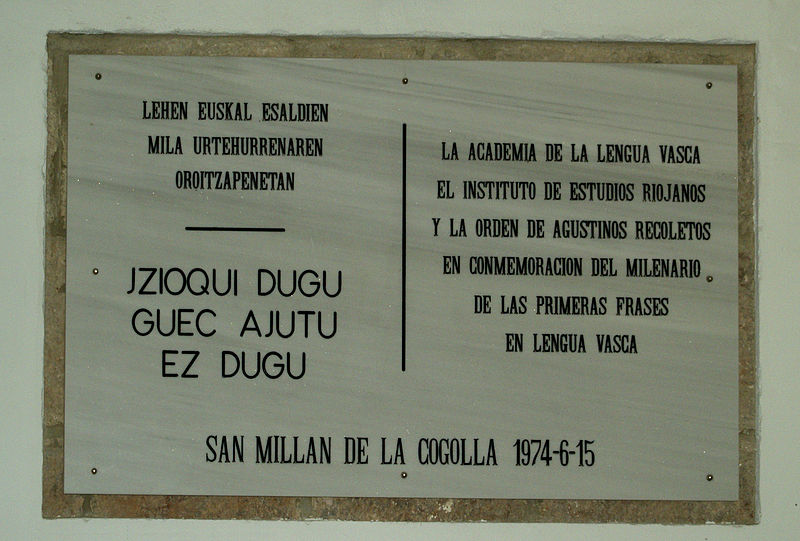
The first phrases in Euskara. Image from Wikimedia Commons.
  • It is now accepted that Basque is related to the now-dead language Aquitanian, that Aquitanian is an ancestral form of Basque. There are inscriptions of Aquitanian names from the first centuries BC and AD that can be related to Basque words; examples include NESKATO (neskato=girl), ANDERE (andere=lady), CISSON (gizon=man), OSSO, OXSO (otso=wolf), and HERAUS (herauts=boar).
  • After the lead tablets, the earliest record of Euskara is from personal names, the earliest of which is Momus, a Latin version of the no-longer-used Basque name Mome. This name appears in the cemetery of Argiñeta in Elorrio, usually dated to 883.
  • The earliest known phrases in Euskara are from the so-called Emilian Glosses from the San Millán monastery in the Rioja. These phrases, from a manuscript dated to 950, are jzioqui dugu and guec ajutu-ezdugu. The meaning of these phrases isn’t completely clear.
  • The earliest known example of a text connecting more than a few words together comes from a magical charm or prayer, dated to the 14th century, that was found in the cathedral of Pamplona in 1957.
  • The longest preserved text we have from before the period before publication began comes from a letter written in 1537 by the first Bishop of Mexico, Joan Zumarraga, to Kattalin Ruiz Muntsaratz with the goal of arranging a marriage between his nephew and Kattalin’s daughter.
  • The first printed book in Euskara is a book of poems, Linguæ Vasconum Primitiæ (“First Fruits of the Basque Language”), published in 1545 and written by Beñat Etxepare. In one of his poems, Etxepare calls for “Heuscara ialgui adi cãpora.” or Euskara jalgi hadi kanpora=Basque, go outside. He wanted Basque to be a more important language.

Sources: Etymological Dictionary of Basque by R. L. Trask, edited for web publication by Max W. Wheeler; The History of Basque by R. L. Trask.

Basque Fact of the Week: Basque Stone Lifters

Anyone who has been to a Basque festival will recognize the rural theme of many Basque sports. Based on activities that would have occurred at the baserri, or farm house, Basque rural sports include wood chopping and sawing, bale lifting, and weight carrying. In fact, the Basque Government has identified 18 of these events in its Strategic Plan. Perhaps one of the most spectacular and popular of these events is harri jasotzea, or stone lifting. There are various variants of stone lifting, from lifting the biggest weight to lifting a smaller weight as many times as possible. In all cases, a successful lift consists of getting the stone to one’s shoulder.

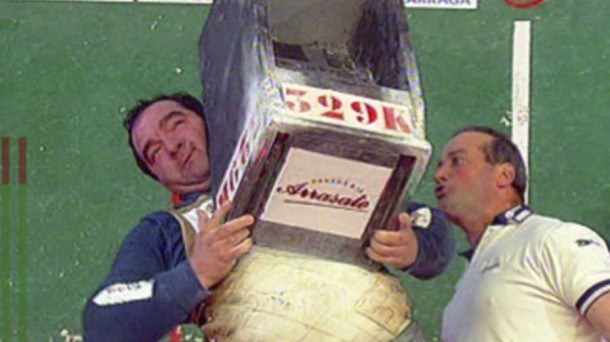
Saralegi with his 329 kilogram lift. Photo from teleame.com.
  • The world record for the heaviest lift is held by Mieltxo Saralegi, with a lift of 329 kilograms, or 725 pounds, a feat which took place in 2001 in Lekunberri. That is, he lifted rectangular rock off the ground and up to his shoulder that weighed over 700 pounds!
  • Perhaps the most famous stone lifter is Iñaki Perurena, who held the previous record at 320 kilograms. He also held the record for the most lifts of a 100 kilogram stone: 1,700 times over the course of 9 hours. Iñaki has become a celebrity in the Basque Country, acting in the TV series Goenkale and writing bertsos.
  • There is a stone, the Albizuri-Handi de Amezketa, that has become almost mythic in the history of Basque stone lifting. Weighing “only” 166.5 kilograms (367 pounds), it is a natural stone with a very irregular shape. While stories swirl that it was lifted in 1875 by José María Zuriarrain Galarza, the first confirmed lift occurred in 1947, by Santos Iriarte (known as Errekartetxo), who barely got it to his shoulder within the ten minute time limit. Aimar Irigoien lifted this stone in 2002, when he was only 16 years old.
  • It wasn’t until stone lifter Bittor Zabala, who lifted between 1910 and 1945, came along that the stones were given standard dimensions and weights. Before that, stone lifters used whatever stones they wished, in whatever shape. Today, all of the stones (with the exception of special stones such as the Albizuru-Handi), are of specific size, weights, and dimensions.

Basque Fact of the Week: Gernika Was Not the Only, nor Even the First, Basque Town Bombed During the Spanish Civil War

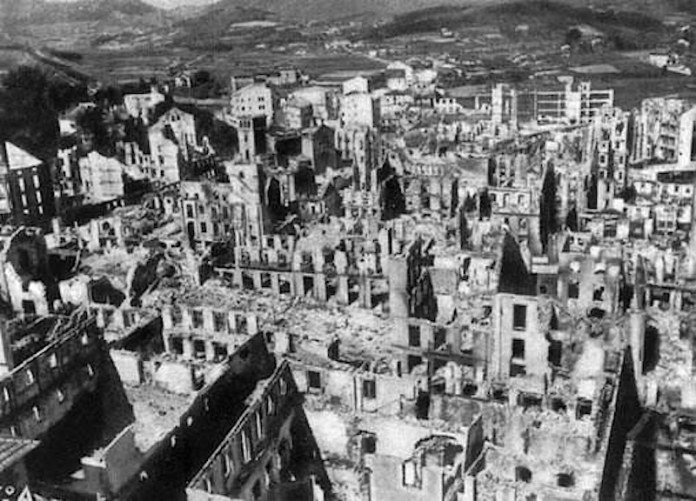
One of the most infamous episodes in the Spanish Civil War is the bombing of Gernika, in which the German Luftwaffe’s Condor Legion attacked the Basque town on Monday, April 26, 1937, starting around 4:30pm in the afternoon. Monday was a market day, normally bringing thousands of people to the small town in the heart of Bizkaia. From the German point of view, this attack was a test of so-called terror bombing, in which civilians are attacked to break the will of the enemy.

Gernika after the bombing. Image from About Basque Country.
  • The town of Durango lies some 28 kilometers from Gernika. It was bombed on March 31, 1937. Durango was viewed as an important transportation junction between the front and Bilbao. German and Italian planes, modified to drop bombs, attacked the town, which had no air defenses. About 250 people died that day. Two churches were bombed during mass, and in one 14 nuns and the officiating priest were killed.
  • Earlier on the same day that Gernika was bombed, the small towns of Gerrikaitz and Arbatzegi (collectively known as Munitibar) were also bombed and machine-gunned. About 11 people were killed during those attacks. Other towns surrounding the mountain Oiz were also attacked, including Markina, Ziortza-Bolibar, Arratzu, Muxika and Errigoiti.
  • The raid on Gernika was originally reported by South African journalist George Steer, who sent a telegram to London describing the bombing and the German markings on the casings. At one point, Steer hid in a bomb crater in Gerrikaitz to escape machine gun fire from German planes.
  • The raid on Gernika was led by Wolfram Freiherr von Richthofen, who was the fourth cousin of Manfred von Richthofen, the infamous Red Baron. Much of what we know about the German planning of the attack comes from his diaries.
  • Of course, the bombing of Gernika is the source of inspiration for Pablo Picasso’s painting Guernica.
  • Though the numbers are uncertain and in some dispute, between 150 and 1500 people died that day. While many modern historians place the death toll to something less of 300 people, Xabier Irujo argues convincingly in Gernika, 1937: The Market Day Massacre that a figure of 1500 is more likely.
  • One of the last survivors of the bombing of Gernika, Luis Ortiz Alfau, died on March 8, 2019.

Random Bits of Basqueness

Found these at our local World Market. Elgorriaga, the first chocolate company in Spain, has been making chocolates since 1770. The company started in Irún, Gipuzkoa.

Basque Fact of the Week: Today is Aberri Eguna, or Basque Fatherland Day

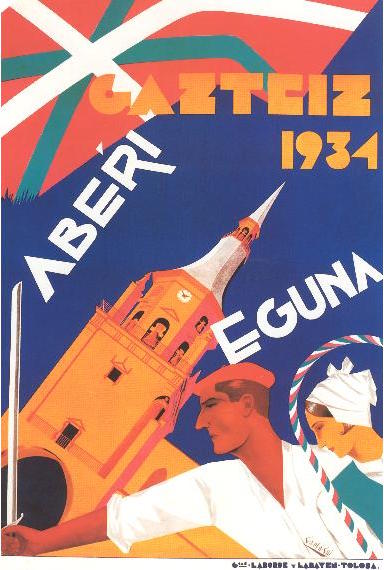
Aberri Eguna On! Happy Aberri Eguna!

Aberri Eguna, coinciding with Easter every year, is a celebration of the Basque Country. It has always had a political aspect, with events organized by the various Basque nationalist parties. However, it has also always had a cultural aspect, which has been more emphasized in Basque communities outside of the Basque Country. While it is not an official holiday, it has become the de facto Basque national holiday and, today, celebrations are often filled with sporting events, dancing, music, food, and drink.

A poster for Aberri Eguna in Vitoria-Gasteis in 1934. From Enciclopedia Auñamendi.
  • The word “aberri” was coined by Basque nationalist Sabino Arana, from his supposed linguistic element “aba”, meaning to him father, and “herri” meaning nation, land, people. While his etymology of the element “aba” is viewed as fanciful today, some of the words he made with it stuck and are used in Basque today.
  • The first Aberri Eguna was celebrated on March 27, 1932 in Bilbao. It was organized by the Basque Nationalist Party (PNV), on the occasion of the 50th anniversary of their founding. The next three were held in Donostia, Vitoria-Gasteiz, and Pamplona.
  • During the time of Franco (1937-1977), and the corresponding exile of the Basque Government, official Aberri Eguna events within the Spanish side of the Basque Country (hegoalde) were rare. However, events were held on the French side (iparralde) and the Basque Government often took to the airwaves to send their messages to their countrymen in the south.
  • In 1964, the Basque Government organized Aberri Eguna in Gernika. This is the first of several in which Aberri Eguna is used as a means to push against the Franco regime. ETA also began to hold its own gatherings on Aberri Eguna, for example in Irún-Hendaia in 1966.
  • In 1975, during another Aberri Eguna event in Gernika, the Flemish deputies Luyten and Juippers hung an ikurriña in front of the Casa de Juntas (where the tree of Gernika stands). They were arrested by the Guardia Civil, prompting Belgium to issue a formal complaint.
  • In 1978, after Franco’s death, celebrations were held in all four Basque capitals in hegoalde: Bilbao, Donostia, Vitoria-Gasteiz, and Pamplona. Together, some 230,000 people participated.

Primary Source: Caballero Basáñez, Carlos. Aberri-Eguna. Enciclopedia Auñamendi, 2019. Found at: http://aunamendi.eusko-ikaskuntza.eus/es/aberri-eguna/ar-6047/

Basque Fact of the Week: In Basque Mythology, Before Humans, There Was a Race of Giants

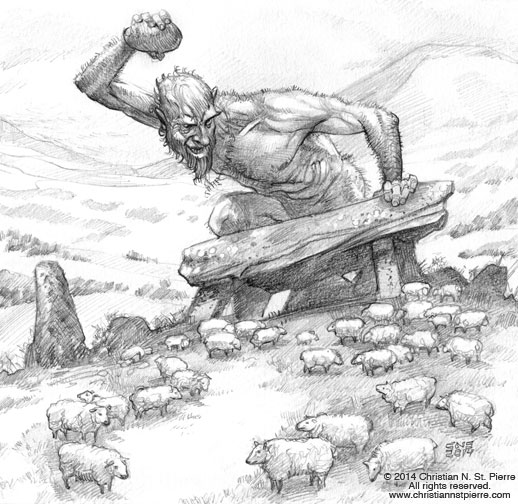
Basques are known for the strong Catholic devotion. However, the Basques are also known to have converted to Christianity relatively late. Before, they had a mythology that was based on various supernatural beings. One of those was the Jentilak, or race of giants. These beings, immense in size, existed before humans, though maybe co-existed with humans, at least in some tales. They had enormous strength and were responsible for the construction of many massive stone features, including churches, castles, bridges, and dolmens. They were said to be more Christian than the Christians. They suddenly died when a black cloud appeared in the sky and they fled to bury themselves.

  • The Jentilak are part of a larger European tradition of giants (think of Jack and the Beanstalk in England). “Modern” influences have corrupted the nature of these beings in these stories, but, at least in the Basque Country, they were originally benign beings.
  • The Jentilak would play games, such as pilota, throwing massive stones through the air that still lie at the foot of some mountains. One rock, near Amil, a part of Motriko, becomes surrounded by water at high tides.
  • The wide-spread belief in these beings is reflected in a number of place-names, including Jentilbaratza, Jentilzulo, and Jentiletxea.
  • The jentilak died suddenly when the black cloud appeared, for no apparent reason (they were not punished, as in the Biblical flood, for past sins). Further, the race that succeeded them — humans — were not as kind nor “Christian” as they were. This has led scholars to interpret these myths as the foundation of religious rites of burial. As translated from the original article in the Enciclopedia Auñamendi: The Jentilak die and are buried under funerary monuments that perpetuate their memory (they die precisely to be buried) and in this way the humans who take them as models learn that they also have to act in the same way with their own deceased: burying them and guarding their memory. This is reflected in the fact that the main cultural obligation in the ancient pagan religion of the Basques consisted in the daily realization of offerings to the deceased of the house.
  • In time, the cloud was reinterpreted as a portent of the coming of Kixmi, or Christ. Olentzero, the Basque “Santa Claus,” was a jentil who, being nearly blind, could look at the cloud and understood its meaning.

Source: Hartsuaga Uranga, Juan Inazio; Hartsuaga Uranga, Juan Inazio. Gentiles. Enciclopedia Auñamendi [en línea], 2019. Available at: http://aunamendi.eusko-ikaskuntza.eus/es/gentiles/ar-62712/

Thanks to Lisa Van De Graaff for suggesting this topic as a Basque Fact of the Week. If you have a topic you’d like to suggest, just let me know!

Basque Fact of the Week: Simón Bolívar, the Liberator, had Roots in Bizkaia

Known as the Liberator, Simón Bolívar is a national hero to many South American countries. Under his leadership, Venezuela, Bolivia, Colombia, Ecuador, Peru, and Panama gained their independence from Spain. He also became president of what was then called Grand Columbia, encompassing the modern countries of Venezuela, Colombia, Panama and Ecuador. Inspired by the American and French revolutions, he envisioned a united Spanish America, though felt that it needed a stronger central government than the United States because of the more varied peoples. Though Bolívar dreamed of a united Spanish America, his dream failed, in part due to the political ambitious of others as well as the fear that he was establishing a dictatorship with him at the helm. He died in 1830 of tuberculosis, at the age of 47.

Statue of Bolívar in Washington, D.C., photo taken by Blas Uberuaga.
  • Simón Bolívar was born into a wealthy family in Caracas in what is modern day Venezuela in the year 1783. His ancestor, Simón de Bolívar, from the village of Bolibar in Bizkaia, left for Santo Domingo, in what is now the Dominican Republic, sometime around 1559. In 1569, Simón de Bolívar moved to Venezuela. The wealth of the family came from a large number of estates and plantations. Simón Bolívar, the Liberator, dedicating his personal wealth to the cause of liberation and revolution, died a poor man.
  • The Bolívar name comes from the small village of Bolibar (current spelling in Euskara) in the heart of Bizkaia. There is a museum dedicated to the history of Bizkaia in the Middle Ages and to Simón Bolívar himself. Bolibar is only kilometers away from where my dad was born, but I have yet to visit the museum. The name comes from the Basque words “bolu” (mill) and “ibar” (valley), meaning “valley of the mill.” The country Bolivia gets it’s name from Bolívar.
  • Bolibar, the village, is very close to the neighborhood of Zenarruza, famous for the Collegiate Church of Cenarruza, which was an important stop on the Camino de Santiago. Zenarruza is a name familiar to Idahoans, belonging to long-time Idaho politician Pete Cenarrusa.

Primary source: Wikipedia.