Basque Fact of the Week: Former MLB All-Star, Andy Etchebarren, Dies at Age 76

Andy Etchebarren was an All-Star catcher for the Baltimore Orioles, a fixture in their line-up from 1965-1975. While his offensive stats were not overly impressive, he was known for his toughness and his defensive skills. He appeared in four World Series, with his team winning twice. Etchebarren had the distinction of being the last player ever to face Sandy Koufax in a game, in Game Two of the 1966 World Series, in his rookie year. Etchebarren died on October 5, 2019.
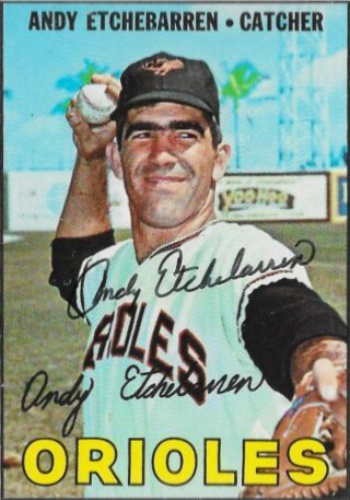
Image from Memorabilix.
  • Etchebarren, the son of a French mother and a Basque-American father, was an All-Star twice, in his first two seasons in the major leagues. His career was plagued with injuries that constantly nagged at him and, after a few years, meant he was sharing catching duties with other players. Eventually, his diminished role led him to demand a trade and he was sent, in 1975, to the then California Angels.
  • Etchebarren was a contender for Rookie of the Year during his 1965-1966 campaign. However, injuries side-lined him and he fell out of contention. He was also, at one time, a contender for MVP, in the end landing in 17th place in the voting. That year’s winner, Frank Robinson, also an Oriole, had fallen into a swimming pool at a party earlier that season. Robinson, not knowing how to swim, started sinking to the bottom. It was Etchebarren who dove in and saved his teammate.
  • Regarding injuries, one story describes how, during a game, a foul tip hit his hand. The first baseman came to see if he was ok. Etchebarren brushed him off, saying he was fine, though a bone was visibly sticking out of his hand. He shoved it back in and continued playing.
  • Of course, Etchebarren isn’t the only MLB player with Basque roots. Perhaps the most famous was Ted Williams, though his Basque roots were never very conspicuous.
  • After his playing career was over, Etchebarren became a baseball manager, coaching at various levels. I guess he was known for his antics. In this clip, he is seen taking away a base after being ejected from the game.

Primary sources: Society for American Baseball Research; Wikipedia. Inspired by a post on Facebook by Xabier Berrueta.

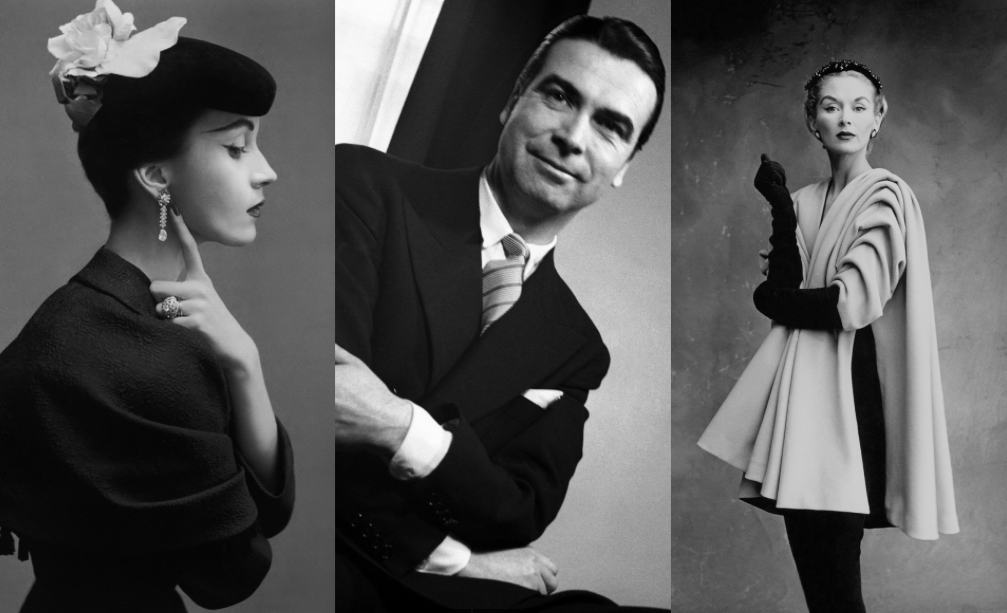
Basque Fact of the Week: Cristóbal Balenciaga Eizaguirre

This year is the 500th anniversary of Magellan’s expedition, which culminated in Juan Sebastián Elcano becoming the first person to intentionally circumnavigate the planet. Elcano hailed from the small Basque coastal town Getaria, Gipuzkoa, just twenty-five kilometers west of Donostia/San Sebastián. However, Elcano is not the only famous son of Getaria and, in fact, isn’t the one that is most celebrated in the town. Rather, the museum that sits in the heart of the town is dedicated to Getaria’s other most-famous son, Cristóbal Balenciaga Eizaguirre.

Image from ArtChateau.
  • Balenciaga, who would become known as “The King of Fashion,” was born in Getaria on January 21, 1895. His father, a fisherman, died when he was a boy. He spent most of his time with his mother, Martina Eizaguirre Embil, who was a seamstress. Formally trained as a tailor, Balenciaga opened his first boutique in Donostia in 1919, soon followed by branches in Madrid and Barcelona. However, the Spanish Civil War forced him out of Spain and he opened a new “couture house” in Paris in 1937.
  • Balenciaga was known for his involvement at all stages of his work. He didn’t just design clothing, he created it, from whole cloth, from start to finish. As Coco Chanel was quoted as saying, ““Balenciaga alone is a couturier in the truest sense of the word. Only he is capable of cutting material, assembling a creation and sewing it by hand, the others are simply fashion designers.”
  • Balenciaga was a very private man who bucked tradition. In all his life, he only gave one full interview. He called his house models “monsters” because of the way he told them to walk down the runway with “empty faces and a Dracula walk.” He preferred that his models have a little stomach as that was the way the real women who wore his clothes were.
  • He is perhaps most famous for redefining the female silhouette. His designs supplanted the then-popular hourglass shape, giving us instead the “sack” dress, the “baby doll” and the “envelope.”

Basque Fact of the Week: Heresy of Durango

Durango, in the heart of Bizkaia, is one of the province’s most important towns. It is the namesake of both the city and state of Durango in Mexico and of Durango, Colorado in the United States. During its history, Durango has been involved in events such as the War of the Bands and bombing during the Spanish Civil War. Founded some time before 1179, Durango has been ravaged by multiple plagues, floods, and fires over the centuries. One of the most intriguing episodes involving the city is the so-called Heresy of Durango.

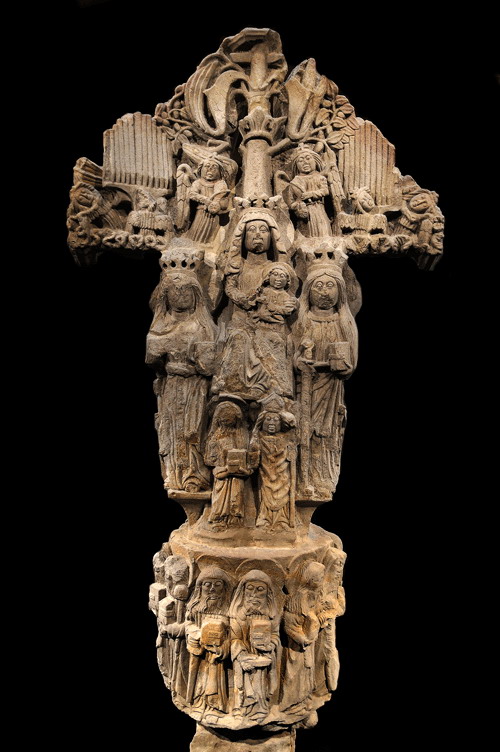
The Kurutziaga Cross, image from Nekatur.net.
  • The Heresy of Durango was a “millennarist movement” that formed in the 1440s under the leadership of Franciscan friar Alonso de Mella. Mella led a sect that was communist in nature, in the sense that it advocated for the communal sharing of goods and women. Indeed, one of the crimes the sect was accused of was the teaching that women who had sex with other members as an act of charity were not committing a sin. The members, comprised of both local nobles and regular villagers, supposedly took the names of various saints. They would announce meetings with trumpets and either meet in town or in the surrounding mountains and forests. There is some thought that this sect was maybe inspired by the Free Spirit movement.
  • Public and religious authorities harshly repressed Mella’s followers. More than a hundred of them were sentenced to death (publicly burned in Kurutziaga, in Santo Domingo de la Calzada or in Valladolid) while others, including Mella and his partner Fray Guillen, managed to flee. Mella made it to Granada, where he seems to have appealed to King Juan II of Castilla to look into the merits of his and his followers beliefs. However, he was later burned to death for his ‘crimes.’
  • In apparent atonement for these heresies, the Kurutziaga Cross was erected on the site where many of the sect’s followers were burned. The cross, carved into sandstone, is about 4.5 meters high and is regaled with figures such as a serpent with a woman’s head and Adam and Eve. You can see it today in the Kurutzesantu Museum.
  • Heretical movements would continue in Durango throughout the 16th and 17th centuries and even into the second half of the 19th century, when a self-styled “prophet” named Manzanero managed to attract a number of followers and create a sect. However, these movements had little impact out of the region.

Primary sources: durango-udala.net, The Basques by Julio Caro Baroja.

This Fact inspired by a passage in Emma Wilby’s upcoming book Invoking the Akelarre: Voices of the Accused in the Basque Witch-craze, 1609–1614.

Basque Fact of the Week: Basque Superheroics

When I was a kid, the world of superheroes was, for the most part, confined to geeks like myself. Today, with the enormous success of the Marvel movies, superheroes are now mainstream like never before. Given the enormous universes and the thousands of characters that Marvel, DC, and the like have created, it is unfortunate that they lack any superheroes with a Basque backstory. However, there was a Basque superhero created in Bilbao, the Burdinjaun.

Image by Iñigo Rotaetxe, found on ArtStation.
  • Burdinjaun, the Iron Lord, lived in an alternative future, in Euskopolis, a mega-metropolis that was ruled by a tyrannical figure, the Gran Dakari. Created in 1987, Burdinjaun had a retractible cesta, or jai alai basket, that he would use to throw balls of steel. He had been exposed to various chemicals and radiation, giving him his powers and converting him into a man that was part iron and part flesh. His adventures pitted him against the Gran Dakari and his brutal police force, led by Beltza, who controlled this dystopian Basque future.
  • While not a hero, and not Basque in origin, Overthrow had some Basque inspiration. A Marvel villain, this guy had a “cybernetic” cesta that threw balls of energy (seems like having a cesta was a common gimmick). Created in the late 1980s, he was one of those characters that took advantage of unique elements from some culture (in this case, a cesta) to build a whole character around. Maybe fortunately, they killed him off in 2005.
  • Perhaps featuring the only Basque superhero starring in a comic written in English, Firebrand is the story of Natali Presano, the daughter of a sorgin, or Basque witch. Born in Seattle, Natali struggles with her powers until she is taken in by her aunt, who is part of an order that is waging an ancient war in the Basque Country. Created by Jessica Chobot, Erika Lewis, and Claudia Aguirre, the story features various elements from Basque mythology.
  • Maybe the most famous Basque figure in comic books, at least in the United States, is Joanes, the Basque Whaler. Created by Guillermo Zubiaga, the comic series details the supernatural adventures of a Basque whaler. The story takes Joanes from the Basque Country to what would be known as the Americas to the depths of the ocean. To ensure success as a whaler, he sells his soul to a sea demon that then haunts his life. Guillermo is right now putting the final touches on issue number 5 of Joanes’ adventures.
  • Before Joannes, Zubiaga was a free-lance artist working for various companies. One of his jobs was ghosting the art on Marvel’s X-Force, a spin-off of the X-Men franchise. As a ghost artist, he wasn’t always given a credit line in the comic, so he left his mark by adding Basque elements to his panels, such as posters for Negu Gorriak concerts and magazines from the Basque Country.

Basque Fact of the Week: Iñaki Williams, Athletic Bilbao Striker

Athletic Bilbao is one of the most tradition-heavy soccer teams in the main Spanish league La Liga. Founded in 1898, they have won the league championship eight times, fourth most in league history, and won the Copa del Rey 23 times, second most behind only Barcelona. They are unique in their player philosophy, only hiring players either born or trained in the Basque Country. Today, one of their most dynamic players is Iñaki Williams Arthuer who became the first black player to ever score for Athletic Bilbao.

Photo from AS.com.
  • Williams was born in Bilbao in 1994. His parents, Félix and Maria Williams, are from Ghana and had crossed the Melilla border fence in Morocco. Melilla is one of two Spanish cities in Africa and this fence separates Spain from the rest of Africa. His parents moved to Iruña/Pamplona for work, and survived through a series of jobs, including picking asparagus, providing cleaning services, working in airports and restaurants, and providing geriatric care. His father eventually had to move to London for work, and Williams rarely saw him growing up.
  • Williams made his debut on the first-team on December 6, 2014, becoming only the second player of African descent to play for Athletic Bilbao. He scored his first goal for the team on February 19, 2015, against the Italian club Torino F.C., the first black player to ever score for the club.
  • The first black player to ever play for Athletic Bilbao was Jonás Ramalho. Ramalho was born in Barakaldo. His father was from Angola. Ramalho debuted for Athletic on November 20, 2011. He now plays for the Second-Division team Girona FC.
  • Like much of the world, Bilbao and the Basque Country has become a global melting pot. In 1992, about 9,000 people immigrated from South America and Africa to the region. In 2016, that number had swelled to more than 41,000.
  • Williams has been embraced by the Athletic faithful. In the Amazon documentary Six Dreams, he says “For me it is a point of pride that black and African people feel proud of me. I want to open what people have in their heads: ‘A black man cannot play for Athletic’, ‘That black man is not Basque’, which is still happening today. You hear or read comments: ‘How can a black man play for Athletic?’ No, no, I’m black, but I’m also Basque, I was born here. I feel Basque and I want to open all the doors to all those people who want to fight and work and strive daily to play in Athletic.”

Primary sources: ESPN and Wikipedia.

Basque Fact of the Week: Biarritz

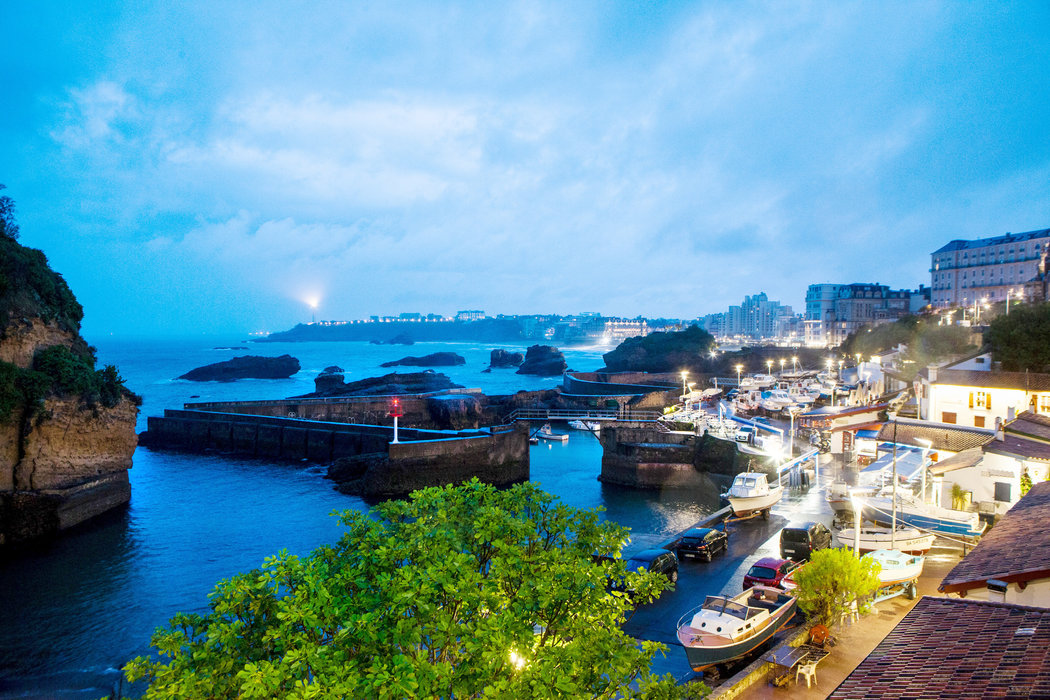
The Basque city of Biarritz, located in Iparralde in the provice of Lapurdi, was recently in the news as it hosted the G7 summit. Much was made of especially the first ladies strolling and visiting what is now a popular tourist and surfing destination. It was a playing spot for kings and queens. But, Biarritz is an old city with an origin that is based in whaling.

Photo from the article 36 Hours in Biarritz in
the New York Times, taken by Markel Redondo.
  • The first mention of Biarritz comes in the so-called Libro de Oro or Cartulario de Bayona, in 1186, in which the city is called Bearids, and later in 1261 it is referred to as Beiarrids. Just a little earlier, in 1168, the same book makes reference to a Galindus de Beariz, who had transferred all of his ecclesiastical assets from the sanctuary San Martín to the church of Saint Mary of Baiona.
  • Biarritz’s entire economy was based on whaling. At one point, Biarritz had watchtowers in which sailors scanned the horizon for whales. When they saw one, they would set fire to wet straw, creating a huge amount of smoke that would alert everyone to the presence of the whale. Whaling was an important part of life and work in Biarritz until about March 3, 1686, when the last whale was hunted. The coat of arms of Biarritz features a whaling crew in pursuit of a whale.
  • In 1609, the persecution of witches reached Lapurdi as Pierre de Lancre investigated cases of witchcraft in this part of the country. In depositions made by several witnesses, it was said that the wizards and witches of Biarritz were known to have a toad leg drawn on their left eye.
  • Biarritz started to become something other than a whaling city when, in 1843, the writer Victor Hugo visited. He praised the small city, writing: “I have not met in the world any place more pleasant and perfect than Biarritz. I have never seen the old Neptune throwing joy and glory with such a force in the old Cybele. All this coast is full of humming. Gascony’s sea grinds, scratches, and stretches on the reefs its never ending whisper. Friendly population and white cheerful houses, large dunes, fine sand, great caves and proud sea, Biarritz is amazing. My only fear is Biarritz becoming fashionable. Whether this happens, the wild village, rural and still honest Biarritz, will be money-hungry. Biarritz will put poplars in the hills, railings in the dunes, kiosks in the rocks, seats in the caves, trousers worn on tourists.”
  • Biarritz became famous as a destination when Empress Eugenie, the wife of Napoleon III, built a palace on the beach in 1854. The palace, now the Hôtel du Palais, attracted many celebrities, including King Edward VII of the United Kingdom, Ava Gardner, and Frank Sinatra.
  • Biarritz is also recognized at the first place someone surfed in Europe. During the filming of The Sun Also Rises, a friend of the director, Peter Viertel, visited from California, bring his surfboard and first surfing the waves of any European beach. Today, Biarritz is a popular destination for surfing.

Primary sources: Estornés Zubizarreta, Idoia; Berger, Marie Claude. BIARRITZ. Enciclopedia Auñamendi, 2019. Available at: http://aunamendi.eusko-ikaskuntza.eus/es/biarritz/ar-13815/; Wikipedia.

Basque Fact of the Week: The Tree of Gernika

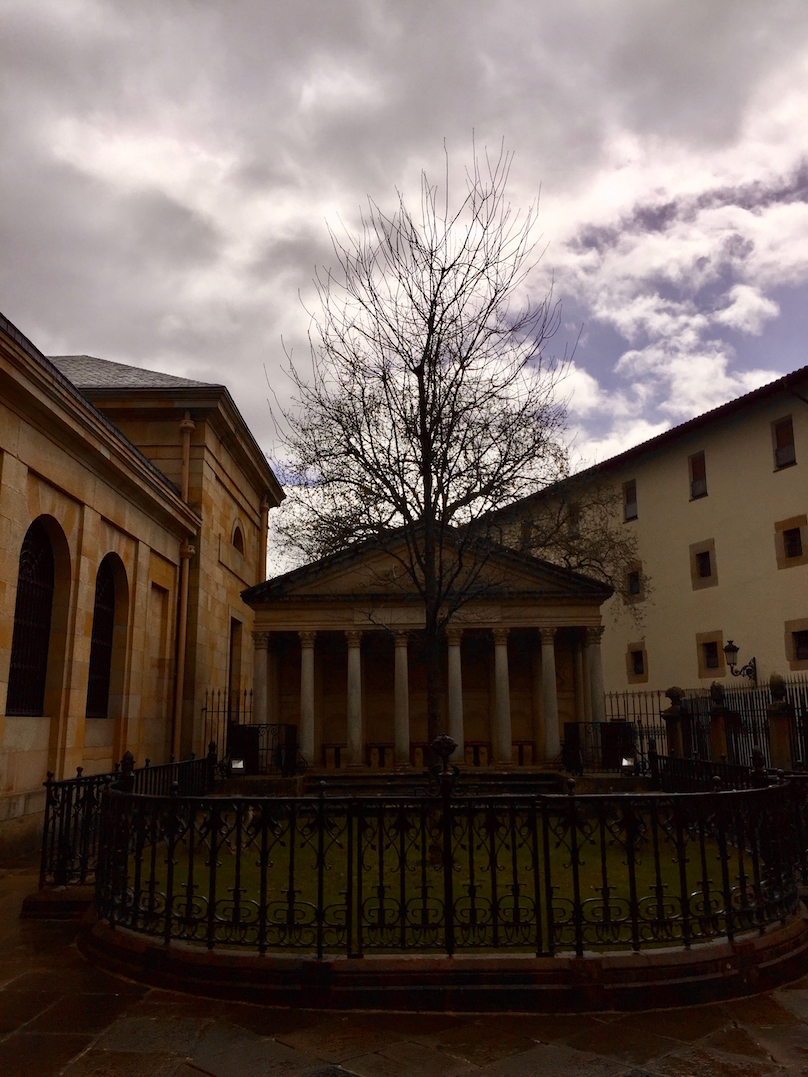
The Tree of Gernika is one of the most iconic symbols of the Basque Country, featuring prominently on the coats-of-arms of the province of Bizkaia and thus of Euskal Herria. The fueros of Bizkaia specifically call out the tree as the place where people came to meet and any Bizkaian captured for any crime had to be brought before the tree. The Lords of Bizkaia, as well as the later Kings of Castile, swore their respect to Basque laws under the tree, up until 1839 when the infant Queen Isabella II and her mother the regent Maria Christina were the last. Today, the President — the Lehendakari — of the Basque Autonomous Community takes his or her oath of office under the tree.

Photo of the Tree of Gernika taken by Lisa Van De Graaff.
  • The Oak of Gernika is not the only such sacred tree in Bizkaia. There are many others, including those of Aretxabalagana, Abellaneda, Gerediaga, and Luyando. The tree in Gernika represented all of Bizkaia, except Encartaciones and Duranguesado, which met under the trees of Abellaneda and Gerediaga, respectively, until Bizkaia was united into one province in the 1600s.
  • The first, “father,” tree was planted in the 14th century and lived for about 450 years. The current tree, which is the fifth, was planted in 2015. The third tree, planted in 1860, survived the Nazi bombing of Gernika, but later succumbed to a fungus and was replaced in 2004.
  • The tree is such a powerful symbol of Basque liberty that it has become the object of numerous songs and poems, both within and without Euskal Herria. Perhaps the most famous song is Gernikako Arbol by Jose Maria Iparragirre:

The Tree of Guernica
is blessed
among the Basques;
absolutely loved.
Give and deliver
the fruit unto the world.
We adore you,
holy tree.

Oak of Guernica! Tree of holier power
Than that which in Dodona did enshrine
(So faith too fondly deemed) a voice divine
Heard from the depths of its aerial bower-
How canst thou flourish at this blighting hour?
What hope, what joy can sunshine bring to thee,
Or the soft breezes from the Atlantic sea,
The dews of morn, or April’s tender shower?
Stroke merciful and welcome would that be
Which should extend thy branches on the ground,
If never more within their shady round
Those lofty-minded Lawgivers shall meet,
Peasant and lord, in their appointed seat,
Guardians of Biscay’s ancient liberty.

A Random Basque Encounter in Oak Ridge

I was at Oak Ridge National Laboratory this week, attending a workshop on the Frontiers of Structural Materials (structural materials are all of the things that hold our buildings, power plants, cars, airplanes together and make them perform). I was presenting on our research center FUTURE and how we are developing experimental techniques to understand defects in materials.

Anyways, when I was done speaking, a young guy came up to me and said “Kaixo! Zer moduz?” He had seen my name and, recognizing it is Basque and being Basque himself, decided to introduce himself. A little while ago I wrote about a random encounter in San Antonio where I heard someone speaking Basque and how that is sort of like a secret handshake. Having a Basque name is similar. Most Basque names are so obviously distinct that it is another form of the handshake, of the “secret club.”

Patxi Fernandez-Zelaia is a scientist here at Oak Ridge studying additive manufacturing. Additive manufacturing (AM), more popularly knowns as 3D printing, is a way of making parts, not by machining or cutting away material, but by adding material systematically to the part to form the shape you want. At Oak Ridge, they are doing this at much larger scales than what you typically see in videos and at homes, working to push these techniques so that they can be used, for example, to print turbine blades for airplanes.

The other day I highlighted the story of Gregorio Salegui Urain, who, unlike many Basques, didn’t come to the United States to be a sheepherder, but as a baker and ice cream maker. Patxi’s parents are another example of Basques who didn’t come to be sheepherders. Patxi’s dad, Humberto Fernandez Urquiaga, was a professional pilotari, playing in places like Miami and Connecticut. He and his wife are both from Markina, very close to Munitibar where my dad was from and the same town where my dad’s sister-in-law Rosario is from. One interesting story I got from Patxi: because the jai alai courts were associated with gambling, kids weren’t allowed, so he never got to see his dad play professionally. This video on YouTube highlight’s Urquiaga’s playing career.

https://www.youtube.com/watch?v=rsorVFcZo24

Basque Fact of the Week: Jordan Valley, the Little Basque Town in Oregon

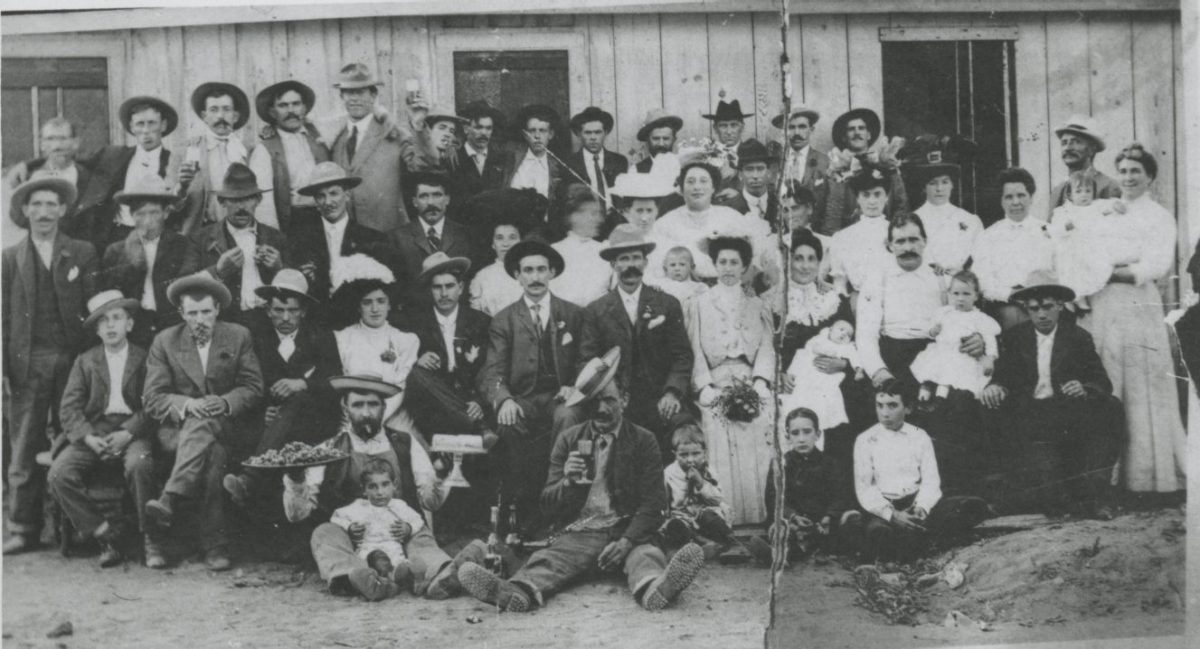
The American West was a strong draw for many young Basques seeking opportunity. Jordan Valley, Oregon, was one of those areas that provided opportunity for young Basques. Jordan Valley first attracted miners around 1863 when gold was discovered. The first Basques arrived soon after, in 1890, as part of the sheep industry. So many Basques came that Jordan Valley became known as “Home of the Basques.” The Basque influence was so strong that, in the early 1900s, Americans living there said they felt like they lived in the Basque Country.

Basque residents of Jordan Valley, c. 1914
Courtesy Oregon Hist. Soc. Research Lib., 21730, found on the Oregon Encyclopedia.
  • The population of Jordan Valley has always been small, maybe about 300 people during the decades of 1910-1930. More than half of the residents were Basque. The Basques lived separately from the American neighbors, retaining their old customs. They were so isolated that their children often only knew Basque and had trouble when they started school, where teachers forbade speaking the language. Their houses often had a touch of green or blue with red roofs, reminiscent of the baserri back home.
  • While Basques probably passed through the area in the 1860s with the discovery of gold, they didn’t really start settling in the area until 1889, when Antonio Azcuenaga and José Navarro arrived. While they were the first, it only took a few decades for Basques to be the dominant population. Many other Basque families followed, including the Eiguren, Elorriaga, Telleria, Yturri, Elordi, and Madariaga families. By the 1940s, 50% of the local farms were owned by Basques and Basques 90% of the sheep owners, according to a study by Joseph Gaiser.
  • In 1914, in cooperation with the local Irish population, the Basque community built the Catholic Church, Saint Bernard’s. They followed up in 1915 with a fronton, the only fronton in Oregon then, and now. After many years of disuse, the fronton was renovated in 1997, with a grand celebration when the renovation was complete (I was there!). About 1500 people, mostly descendants of the Basques of Jordan Valley, came to the celebration.
  • Because of the strong Basque identity, Jordan Valley was, with maybe the exception of Boise, the only place were certain traditions were still practiced. For example, on New Year’s Day, young men would go from house to house, singing Urte Barri Ekarri (Bringing the New Year), hoping for a drink from each house. Children did something similar on the day of Saint Agueda, hoping for bacon and sausage as their reward.
  • Even as late as 2001, Basque names abounded in local businesses. Aiden Madariaga was the owner of the Sahara Motel and the Chevron gas station. Jim Zatica was the owner of the Basque Station Motel and the Texaco gas station. Robert Telleria (my uncle!) was the owner of the town’s only supermarket, Telleria’s Market (sadly, I can’t find a single photo of the Market, run by my grandpa for many years before my uncle took over, online). Brother and sister Jim and Marcia Elordi were the owners of the bar, J.V. Club and Coffee.

Primary source: Totoricagüena Egurrola, Gloria Pilar. Estados Unidos de América. Oregón. Enciclopedia Auñamendi, 2019. Available at: http://aunamendi.eusko-ikaskuntza.eus/es/estados-unidos-de-america-oregon/ar-49293/

Basque Fact of the Week: The Basque Ice Cream Maker

We are all familiar with the Basques who, like my dad and his uncles before him, came to the United States on contracts to herd sheep. They all came looking for opportunity and for a better life than what they could make back in the “old country.” But, sheepherding wasn’t the only route to a new life. Take the story of Gregorio Salegui Urain, as told by Koldo San Sebastián and Ana Vega Pérez De Arlucea.

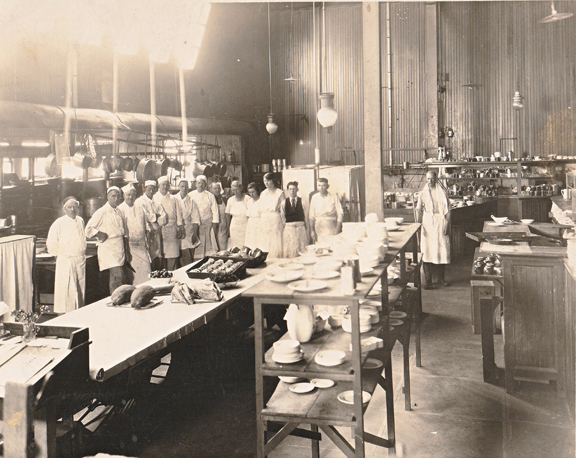
The kitchen at the St. Francis. Gregorio is the second person from the left. Image from The Center for Basque Studies blog.
  • Gregorio was born in Itziar, Gipuzkoa, not far from the border with Bizkaia, on February 14, 1889. He was one of eight children, though two sisters had died not long after being born. He had been sent out to apprentice as a carpenter, but he didn’t take well to his presumed occupation. To escape the military draft, he left to make his fortune in the United States, arriving in New York in 1909.
  • He had traveled to New York with José Uruazabal and his family. José already ran a fruit shop in the city. Gregorio boarded with the Uruazabal family, including José’s brother Frank, who made ice cream. Gregorio soon found work in the same ice cream parlor where Frank worked.
  • Gregorio’s sister, Concepción, and her husband Eufemio Lizarzaburu had found their way to the Pacific Northwest. Gregorio joined them in Oregon, working on a ship.
  • His ice-cream career took a hiatus as he was called into service during World War I. He served as a cook for a few months before being discharged for medical reasons.
  • Back in civilian life, he ultimately found work at the famed St. Francis hotel in San Francisco, working for Victor Hirtzler. The hotel was famous for its cuisine and the celebrities — such as Charlie ChaplinDouglas Fairbanks, Cecil B. DeMille, Sinclair Lewis, and Isadora Duncan. The famous menu included many ice creams, with flavors such as nectarine, peach, banana, pineapple, vanilla, and coffee that undoubtedly were created or influenced by Gregorio.