Hard times brings out the best and worst in people, pushing them in directions they may never have ever imagined. Such is the case of Txomin Letamendi. An extremely talented musician, the Spanish Civil War and its aftermath pushed him to become first a soldier and then a spy for the Basque government in exile, a role that would ultimately cost him his life.
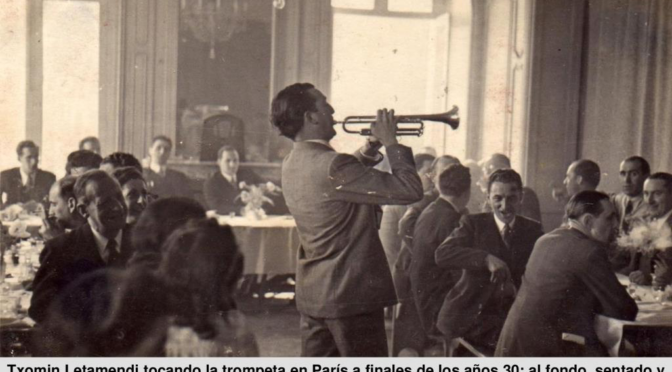
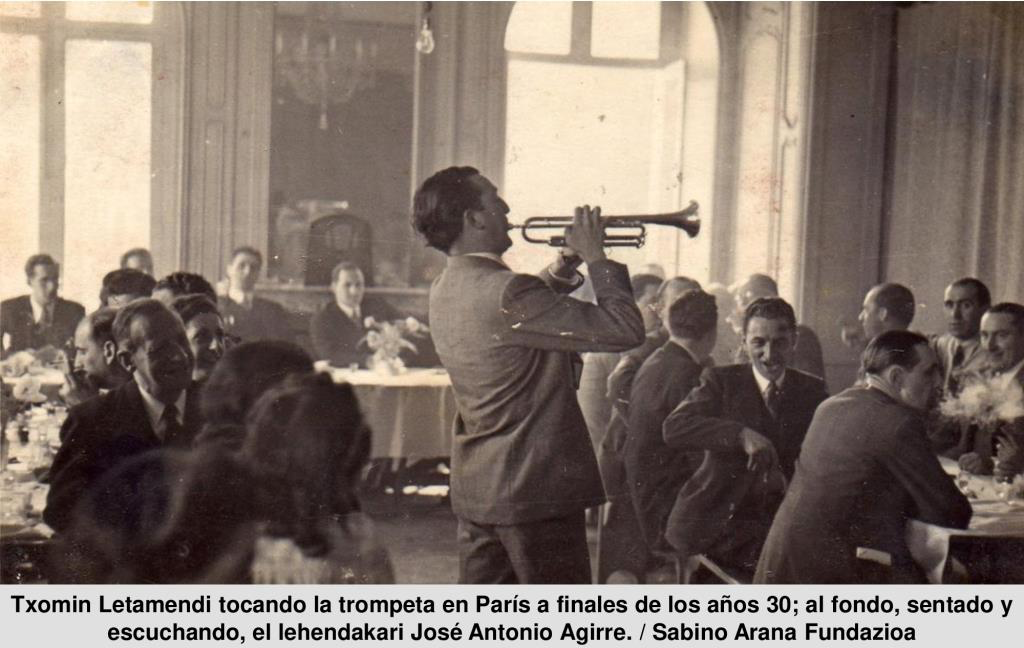
Txomin Letamendi playing the trumpet in Paris in the late 1930s; Lehendakari José Antonio Agirre is in the background. Photo from Deia.
Txomin Letamendi Murua was born in Bilbo in 1901. His family originated from the Oñati region. His father abandoned the family when he was young and his mother ran a bakery in Bilbo.
Txomin was a skilled musician. He played multiple instruments, including the double bass, guitar and oboe, but the trumpet was his main instrument. As a young man, he secured a place in the Bilbo Symphony Orchestra as a trumpeter where he played with, amongst others, Maurice Ravel. In the evenings he would play in cafes, eventually forming a jazz band with some friends. In 1923-24, he played in New York City, including at Carnegie Hall, where he acquired his prized possession, his Conn Silver Trumpet.
Knowing the mountains of Bizkaia, he joined the Aritzimuño battalion of the Basque Army when the Spanish Civil War broke out. He was part of the anti-aircraft defense during the air raids on Bilbo in 1936. Later, he became the commander of the battalion, commanding some 600 soldiers, who participated in battles near Vitoria, Otxandiano, Gorbeia, Barazarre, Sollube, and Lemoatxea. He was well regarded by his soldiers and during the defense of Bilbo he climbed the walls and played Agur Jauna on his trumpet. When Bilbo fell, Letamendi went into exile in Paris.
In Paris, he found a job as a trumpeter in a tango orchestra at an Uruguayan establishment. He made contact with the musical group Eresoinka which, commissioned by the Basque lehendakari in exile José Antonio Agirre, acted as a cultural embassy for the Basque Government, promoting and preserving Basque culture. It was during this time that he met Karmele Urresti, a nurse from Ondarroa, who would become his wife. Their first daughter was born in Paris but when Paris was about to fall to the Nazis, Eresoinka was dissolved and Letamendi and his family fled to Venezuela.
In Venezuela, Letamendi began work in the intelligence services. Still playing his trumpet, he made contact with many people, including the ambassador of Franco’s government, Letamendi was recruited by the United States Office of Strategic Services to gather information on the Venezuelan government, the Nazis who were settling there, and the Franco embassy.
A key goal was to determine the Venezuelan government’s attitude towards the Nazi government of Germany. Having a good relationship with the Spanish ambassador, Letamendi and his band invited him to a special performance, where they stole his keys, entered the embassy, and stole documents from the safes; they returned the keys before the performance was done. This revealed that Spain had been helping Nazis escape Europe, smuggling diamonds, and participating in money laundering.
At this time, Letamendi was ordered by Agirre to return to Spain and work for the Basque government’s clandestine intelligence service. The family eventually made their way back to Bilbo by way of Barcelona and Ondarroa. He coordinated teams of informants in both Bilbo and Madrid. In 1946, he fled to Donostia to avoid the secret police. He was captured trying to retrieve a package at the Donostia train station. He was arrested, tortured, and sentenced for two years. While in prison, his third child was born.
Upon his release, he took over as the clandestine representative of the Basque Government in Barcelona. He was soon arrested again. Fearing this was his last arrest, he asked his wife to raise their children with patriotism and the Basque language, which he himself did not know. He was brutally tortured. His extremely bad health, due to torture and a hunger strike, led to an early release in 1950. He died a few months later in his home in Madrid at the age of 48.
People in the Basque Country are inherently multilingual. Surrounded by Spanish and French, and with their own language Euskara, many also learn English. A recent study has revealed that being multilingual, especially if you speak four languages, has a tremendous benefit for your brain, making it up to thirteen years younger than people who only speak one language.
Image from Nautilus describing this work. Ironically, they don’t have Basque represented…
This work has three aspects. First, the research team compared the age of people’s brains across 27 European countries in a study that spanned some 86,000 people. In that first study, they found that countries with a higher level of multilingualism – with a greater number of people speaking more than one language – had populations that experienced less accelerated aging of their brains: their brains didn’t age as fast. And, the more languages spoken, the greater the effect. They conclude that, even when someone is speaking only one language, they still have to control those other languages in the background and that makes the brain work harder (my words, not theirs).
This study was followed up by another in which they looked at individuals, not country-wide populations. This work was recently presented by Dr Lucia Amoruso from the Basque Center on Cognition, Brain and Language in Donostia, The team started with measuring the age of brains in a random selection of people to calibrate brain age. They used a set of 728 people to develop a “brain age clock” with the combined use of neuroimaging – specifically magnetoencephalography – and artificial intelligence. This brain clock essentially says what the typical age of someone’s brain is for their real age and other factors. This established a baseline to measure deviations from the normal, if you will.
And this is where the Basque connection comes in. They then compared this model against the measured age of brains of a group of 144 people from the Basque Country. The Basque Country was chosen because of the relatively high level of multilingualism and the high variance in multilingualism. Of those 144 people, they had equal numbers that spoke one, two, three, or four languages: Basque, Spanish, French, and/or English.
What they found is that people who speak two languages have brains that are about 6 years younger than what would be expected for their age. If you speak three, you gain 7 years. Four languages gives you 13 years. Thus, they found a huge benefit for in brain age as you speak more and more languages.
They also found that you have to have high proficiency in the languages and speak them from an early age to get the most benefit. So kids that routinely speak multiple languages will see the most impact.
Why does this matter? Not only does it show how speaking multiple languages helps with brain health, but it also suggests how societies can improve the overall brain health of their people by promoting multilingualism in education. It also has relevance for potentially mitigating the effects of diseases like Alzheimer’s that are characterized by brain deterioration. There is a lot of work to do before it gets that far, but it offers one route to help limit the effects of such diseases.
A full list of all of Buber’s Basque Facts of the Week can be found in the Archive.
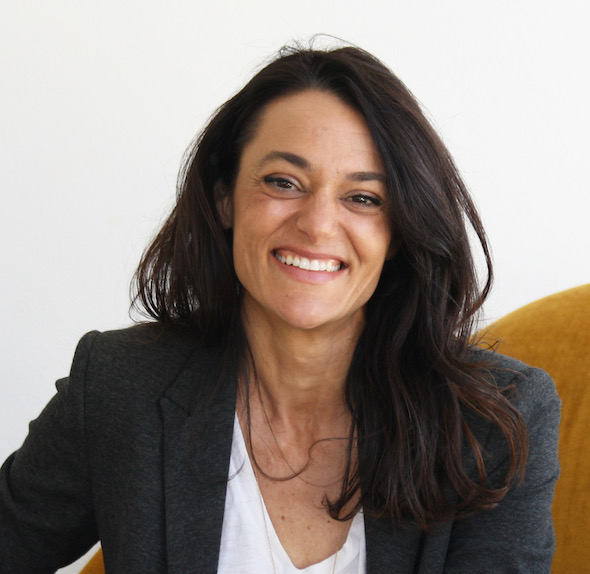
Begoña Echeverria is the daughter of Basque immigrants to southern California. A native Basque speaker with a PhD in sociology, she is a Professor at UC Riverside’s School of Education. Her research on Basque language, culture and identity has appeared in academic journals in education, sociolinguistics, anthropology, history and folklore. Begoña has published “Witches” and Wily Women: Saving “Noka” Through Basque Folklore and Song,” and is also a singer-songwriter with the Basque-American trio, NOKA. Her historical novel, The Hammer of Witches, loosely based on the 1610 burnings of Basque “witches” from the Baztan Valley in northern Spain from which her family hails, was the Historical Novel Society’s Editor’s Choice for May, 2015. Other creative works include Apparitions, inspired by the supposed sightings of the Virgin Mary in the Basque Country in the 1930s, and the play “Picasso Presents Gernika,” staged at United Nations headquarters in New York City in 2023 to commemorate World Refugee day.
On April 26, 1937, the Basque city of Gernika was bombed. This, and other disastrous events during the Spanish Civil War, led to thousands of Basque children being evacuated from the Basque Country. In their play, Picasso Presents Gernika, playwright Dr. Begoña Echeverria and creative director Dr. Annika Speer, both professors at the University of California, Riverside, explore the human toll that the bombing, the war, and the evacuation had, particularly on the children. In this interview, they discuss the origins of the play, why a docudrama was the right way to present this story, and how the collaborative experience keeps evolving in unexpected directions.
With Jacqueline Postajian, a screenwriter and director from Los Angeles, they have turned their play into a film, Children of Guernica. They are in the final stages of filming and production. More details about the film and an opportunity to help with fundraising for the film can be found their Creative Visions site.
Buber’s Basque Page: Let’s begin with a little introduction. Can you each introduce yourselves and say a few words about how you found each other for this project?
Begoña: I am the daughter of Basque immigrants who settled in Chino, CA. I am also the Faculty Director of University Honors at UC Riverside, and a Professor in the School of Education. I met Annika through our colleague Bella Merlin, who’s featured in both the play and the film. I met Jackie through Mario Verlangieri, a music producer with whom I’ve been recording Basque songs.
Annika: I’m a professor in the Department of Theatre, Film, and Digital Production. My colleague and friend (Acting Professor Bella Merlin) initially put Begoña and me in touch because she knew we would have a lot to discuss. Begoña had written Picasso Presents Gernika, a docudrama play, and I wrote my PhD dissertation on docudrama. After years of collaborating on the play we knew we wanted to make a film. Since neither of us are film directors we were searching for the right collaborator and Mario put us in contact with Jackie.
Dr. Annika Speer is a Professor of Teaching in the Department of Theatre, Film, and Digital Production at UC Riverside where she runs the public speaking program. She is the Co-Director of the Public Speaking Initiative, a UC-Wide program based out of UC Santa Barbara that prioritizes interdisciplinary training in speech and rhetoric. She prioritizes communication pedagogy through close work with numerous campus programs, providing a large variety of public speaking workshops for the Graduate Student Resource Center, the Chancellor Research Fellows, the Science to Policy Certification Program, and the Social Entrepreneurship Engagement and Development (SEED) Lab, to name but a few. Speer is also supporting faculty of the Medical Health and Humanities Studies (MHHS) program: https://anthropology.ucr.edu/minors/mhhs In addition to academic work, Speer works as a dramaturgical researcher and script consultant for film, most recently for The Girl on the Train (2016), Men, Women & Children (2014), Walking Stories (2013), and Call Me Crazy: A Five Film (2013). She has directed plays as fundraisers for Women Help Women, Planned Parenthood, and Pacific Pride Foundation with the mission to generate collaborative, creative, and activist oriented theatre.
Jacqueline: I’m a screenwriter and director from Los Angeles. I’ve been working in entertainment for nearly ten years and have completed two short films. Mario was the sound mixer on one of my previous short films, Souvenir Drunk, and I was delighted and honored that he suggested me for the job. After watching the recorded version of the reading of Picasso Presents Gernika at the United Nations, I immediately knew I wanted to help tell this story.
BBP: That Children of Guernica is happening must mean that the reception of your play Picasso Presents Genika was quite exceptional. How does it feel that your play was so well received? What was most surprising about how people responded to Picasso Presents Gernika?
Begoña: It’s very gratifying but also a little disappointing; I would prefer that the themes of the play were no longer relevant. It’s been surprising — and sobering — to see the connections audiences have made between this little-known Basque story from almost 90 years to their own stories of displacement or family separation in far-flung locales in the present. But it’s also been surprising to see how the play seems to bring closure for some Basque descendants of the evacuees, and has elicited stories from the families of survivors that I’d never heard before. This has inspired me to keep telling this story.
Jacqueline Postajian is an American indie filmmaker, screenwriter, and podcast host based in Los Angeles. She is best recognized for directing narrative short films centered around community dynamics and her work analyzing cinema history. Postajian was born and raised in Los Angeles, California. She later attended the University of California, Los Angeles (UCLA), where she earned a degree in Applied Linguistics. Her creative work focuses heavily on human connection, cultural subcultures, and genre experimentation.
BBP: Clearly you’ve told at least part of the story in Picasso Presents Gernika. What motivated you to extend the story to a film?
Annika: Initially we had additional theatrical events planned for the play, but COVID happened, theatres closed, and the opportunities we were looking forward to unfortunately were no longer available. In that moment, I suggested that we edit the filmed version of the staged reading so that we could still allow the story to reach audiences. We were delighted with the reception that we had for the story (at universities, museums and cultural centers, conferences etc.). However, a filmed version of a staged reading is not the most artistically engaging form of storytelling. This inspired us to take the seed of Begoña’s original play but adapt it into a script intended specifically for film. Although we are passionate about theatre, it is a more ephemeral medium, and we loved that film gave us the chance to work with the story from a different angle and to reach a broader audience.
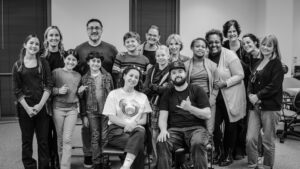
The cast and crew of Children of Guernica.
BBP: In your view, why is it important to tell this story now?
Jackie: In a moment when histories of war and displacement are repeating themselves across the globe, Children of Guernica unfortunately remains relevant as ever. Film is and always will be an empathy machine. As audience members follow the journey of one Basque child refugee into adulthood, we hope to remind them that the most vulnerable, women and children, often pay the heaviest cost in war and conflict universally. Recent events have shown us how fragile and hard-won freedom is. One of the things I love most about Children of Guernica is the sacrifice at the center of the narrative. By telling this story, I hope to deepen public understanding of the human price of liberty—and the strength it takes to choose freedom for someone else, even when it means losing them.
During tough times, people find a way. The aftermath of the Spanish Civil War was brutal for many. In the Basque Country, and beyond, the resulting food shortages led enterprising folks to devise new ways to make and deliver food. One curious – to me – example is the wandering noodle men or fideogile ibiltariak. They would wander from village to village and make batches of pasta to sell to the locals. I imagine that this kind of thing happens everywhere when times are tough. For example, I would think it happened during the Great Depression – does anyone know of similar things that happened in the United States?
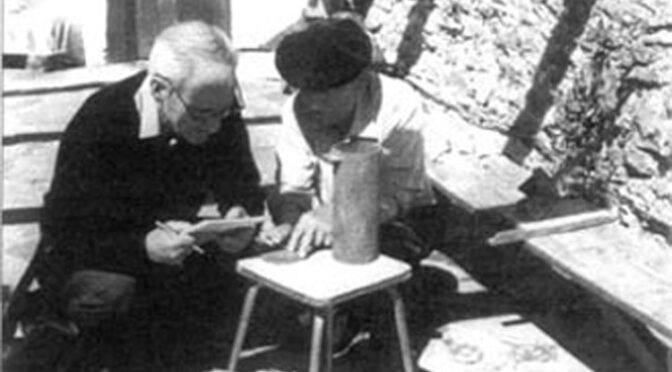
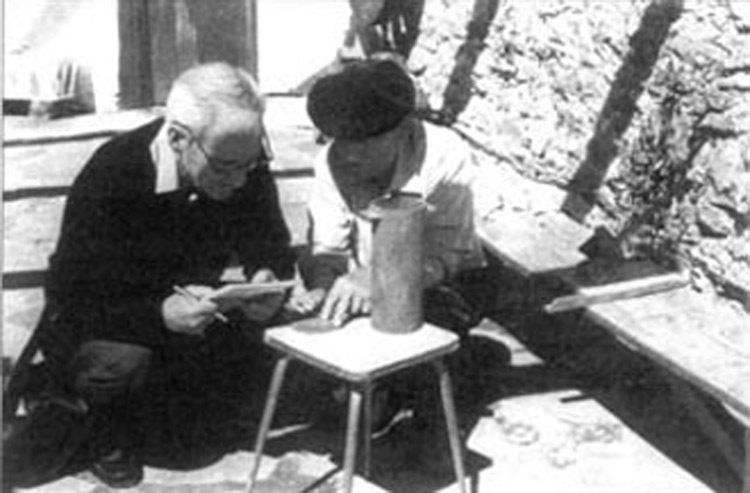
Segundo Lopez de Arana and Julen Zabaleta discussing how the machine for making noodles and macaroni works (Photo by Isidro Saenz de Urturi 04/2002, from Gipuzkoako Foru Aldundia).
After the Spanish Civil War, times were tough for people. There were severe food shortages and food and other supplies were rationed. However, as in all times, hard times create opportunities for some, and the food shortages led to wandering pasta makers, who were quite prolific until the 1950s when things started to improve in Spain.
Many pasta makers – fideogile in Basque – worked out of their own home so didn’t wander. But there were others that moved from town to town – fideogile ibiltariak – working in the kitchens of baserriak and houses of their customers. Usually, pasta making was a secondary job for these people, supplementing the income they made from their main job.
The first itinerant pasta makers in the Basque Country were from Asturias and Valencia. Making their way first to Araba, they would go door to door and sell their services. They brought with them machines to make pasta and enterprising young Basques learned to copy these machines and make their own. It was a hard job making these machines as they didn’t have good supplies for parts. They had to salvage materials from scrap.
Not only was making the machines hard, but so was making the noodles themselves. Flour was in short supply and often had to be smuggled. The customer was responsible for getting the flour. Making the dough was the hardest part, “because it had to be thick. If it came out thin, the work could go to hell.”
When people from a certain village wanted to hire the services of the traveling pasta makers, or the fideoen gizona – the noodle man – they might put an ad in a newspaper. When the noodle man came to town, his arrival was announced by the pealing of the bells. A typical order was for 2-20 kilograms, or 4-40 pounds. However, some people acted as resellers, ordering more than 200 pounds of noodles to sell in Bizkaia and Gipuzkoa.
A full list of all of Buber’s Basque Facts of the Week can be found in the Archive.
I remember my dad having a bota bag around. I don’t remember him using it much, but it was one of the few things from the “old country” that he had around the house. Maybe when he was a sheepherder, he used it more – I don’t know. But, for me as a child, it was one of those symbols of the Basque Country and this strange place dad came from. And, when I was older, I had to get one of my own. It also doesn’t get much use – I’m sure to the chagrin of any zahatogile or maker of bota bags. But it reminds me of dad.
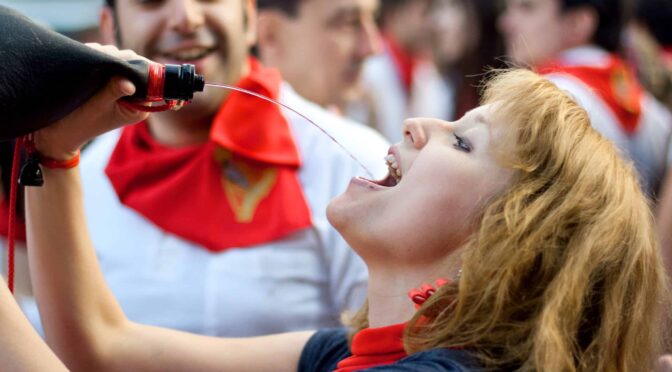
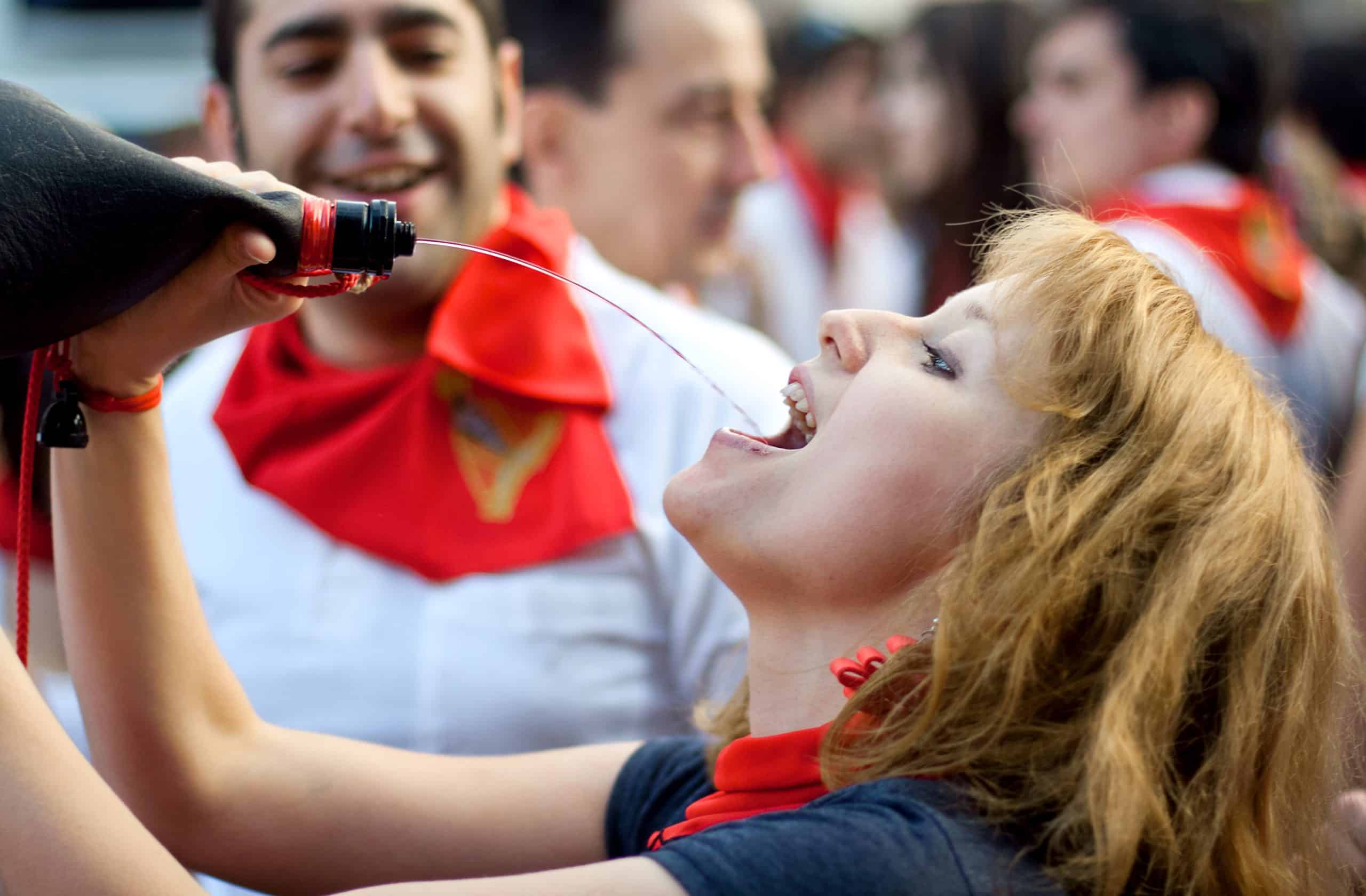
The right way to drink from a zahato or bota bag. Photo from Las Tres ZZZ.
Wineskins, zahatos, or bota bags have been used by people for millennia as a way of transporting drinks and keeping them cool. While some skins are large – the size of the animal they are made from and can carry some 120 liters (about 30 gallons) – zahatos and bota bags are meant to be carried by individuals. They are much smaller, holding between 1 and 4 liters (1/4 to 1 gallon), depending. Traditionally, zahatos or bota bags were used exclusively for wine. These days, with latex linings, they can be used to hold any drink.
The original zahatos – or Basque bota bags – were made of goatskin and soaked in resin inside to keep it water proof. The mouth was made of originally of wood and then bull horn. Today, these types can still be found but modern variants can also use latex to seal the inside. The mouth now is made of rubber in many cases or even more modern materials. Regardless, a red cord is attached to the mouth and wrapped around the bag to be used as a strap for carrying.
For zahatos with wax or resin linings, the lining takes on flavor from the wine: “Wineskins improve good wines and make poor wines good.” They have to be used all the time, or the resin will stiffen or worse; the worst thing one can do with a bota bag is not use it.
A distinctive feature of the zahato is that the mouth releases a small stream of wine. This means that you don’t have to put your lips to the mouth to drink. Instead, you can shoot the stream into your mouth from a distance. This is called the zurrust technique.
Perhaps the most famous brand of zahatos is Las Tres ZZZ of Pamplona. The company started in 1873 as Botería Eusebio Iglesias, owned by of course Eusebio Iglesias. He hired Gregorio Pérez from Huesca as an apprentice and Gregorio took over the business in 1902 when Eusebio retired. In 1914, Gregorio and his wife had triplet girls and he started branding his bags with the three ZZZ in their honor, after the Spanish word zagalas which means young girl or shepherdess.
A full list of all of Buber’s Basque Facts of the Week can be found in the Archive.
This one is a bit technical and maybe the Basque connection is a little loose, but (nerd alert!) I think this is fascinating. Crowd dynamics or simulation is a field in which scientists try to understand how collections of people move and how that movement changes when conditions change. Think of crowds and how they might move normally on a sunny day versus when a tragedy strikes. It is very hard to study the second case as these are unexpected events. However, understanding them is critical for emergency response as it allows responders to better anticipate how the crowd will react in an emergency and public space designers how to design better spaces to mitigate the potentially dangerous consequences of out-of-control crowds. How does the Basque Country come into this? Well, the Running of the Bulls in Iruña (Pamplona) provides an excellent model for such crowds.
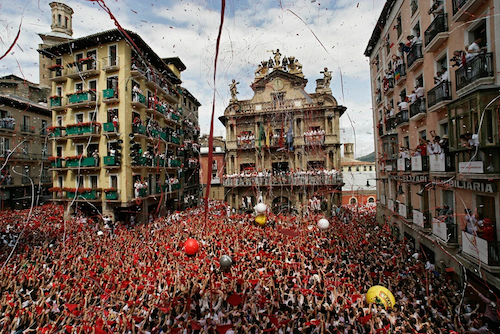
Crowd in Iruña (Pamplona) just before the Chupinazo, or when the Running of the Bulls begins. Photo from NBC News.
The Running of the Bulls is a unique situation in which people are fleeing from something, in this case the bulls of course. Understanding the way that crowds of people flee from danger is important for designing escape routes and managing crowds in emergencies. Further, in these situations, there is a high degree of competitiveness – people trying to outrun their neighbor to safety. However, it is quite hard to characterize the motion of such crowds as they are often unplanned, spontaneous events and, typically, there are more pressing concerns including the safety of the people. The Running of the Bulls affords a somewhat controlled and, importantly, repeated event in which such dynamics can be studied.
Two studies by Iker Zuriguel of the University of Navarra and his colleagues analyze the crowd dynamics of people at the running of the bulls. The first study, published in the Proceedings of the National Academy of Sciences in 2021, analyzed the dynamics of the crowd by considering the individual and collective velocities of the runners. A key concept in the study of crowd dynamics is the speed-density relationship. In normal situations, as the density of people increases, the pace at which the crowd moves slows. We are all familiar with this, as it happens all the time in our daily lives. It comes about because we are trying to avoid contact with others and thus have to slow down. However, as the density of the crowd decreases, we are all able to walk at our preferred pace.
The Running of the Bulls offers some challenges to the normal assumptions in crowd dynamics because there is a moving threat – the bull – that causes people to act differently. In particular, as a bull comes into the field of view of the runners, both the density and the velocity of the crowd increase. In some ways, this makes sense as people start running from the bull and into one another. But it is a very different behavior than what we experience when there is no threat. And, how fast a given runner wants to run changes with time. There is no default level that they would go if no-one else was there – it depends on if the bull is there or not.
However, there is a maximum in the speed-density relationship in that as the density gets high enough, the speed doesn’t get any faster. And this is because falls play an important role in mitigating the speed of the crowd. As people fall, they cause pileups and slow down everyone around them.
In a second paper published in 2025 in Nature, some of the authors follow up on the first study to consider the dynamics of massive crowds compared to smaller ones. They essentially derive a model of crowds that ignores the individual “properties” of each person and instead considers the collective behavior. This is what physicist do to describe fluid flows, for example, where they ignore the individual properties of, for example, water molecules and instead describe the collective.
Much like a physicist would do for fluids, the researchers considered the state of the crowd by considering how the density and speed of people varied with time and with position in the crowd. So, they essentially average out the behavior of individuals and turn them into a “field” that describes the local properties of the crowd.
One of the most interesting observations is that, when the crowd becomes dense, even before the bulls are released, groups of hundreds of runners move in concert, though they have not communicated at all with one another. Different groups move in different ways, but each cluster moves together, as if they are tied together somehow.
What’s more, the speed oscillates. That is, groups of people speed up and slow down with a frequency in time that is very regular. There is nothing to guide them or set this frequency, it comes about naturally in the crowd. The frequency in this case is about 18 seconds. Every 18 seconds, groups speed up and then slow down. Further, this motion is a swirling of groups of people within the crowd. It isn’t just them moving back and forth, but moving through the crowd. These oscillations arise because of the confinement of people: the smaller the space they are packed in, the bigger the oscillations.
Why does this matter? The authors suggest that the frequency of motion of crowds could be monitored in real time and that as they reach a critical value, that might signal that a dangerous crowd behavior might be about to occur, such as a stampede.
A full list of all of Buber’s Basque Facts of the Week can be found in the Archive.
With the World Cup, the world is ablaze with soccer fever. With several premier teams, the Basque Country has a strong association with soccer. There are a number of Basque players participating in the World Cup as part of the national teams of Spain, Ghana, Mexico, and Japan – Euskal Kazeta has a nice writeup about them. Here, we’ll look beyond players and instead at managers and coaches, not just at the World Cup but around the world. There are an inordinate number of premier coaches around the world that are from the Basque Country. Many of them are from Gipuzkoa. It is a remarkable moment in soccer. Here are a few of those coaches.
A number of Basques have had major success coaching soccer at the international level. Photos from the respective Wikipedia articles.
Imanol Alguacil Barrenetxea was born in Orio, Gipuzkoa, in 1971. He played professionally from 1989 to 2003, primarily with Real Sociedad. His career was plagued by injuries and he retired from playing in 2003 to coach, first to the youth team of Real Sociedad before eventually becoming the manager of Real Sociedad from 2018-2025, whom he led to a Copa del Rey win over Athletic Bilbao in 2020, the first win for the club since 1987. In 2025, it was announced that he would become the manager of the Al Shabab Club in Saudi Arabia.
Xabier Alonso Olano has had an outstanding playing career, often considered one of the best midfielders of his generation. He was born in 1981 in Tolosa, Gipuzkoa, and played for multiple top teams, including Real Sociedad, Liverpool, Real Madrid, and Bayern Munich. Over his career he was part of teams that won the Spanish La Liga and Copa del Rey, the Champions League, and the Bundesliga. In 2017, he retired from playing and began coaching, starting with Real Madrid’s youth team. He was named the head coach of Real Madrid in 2025 but left after a year and was just named the new manager of the Premier League team Chelsea.
Jagoba Arrasate Elustondo played professionally for 10 years but only made 10 appearances during that time, mostly for second tier or lower teams. In 2007, he switched to coaching, with stints at Real Sociedad and Mallorca, though his longest tenure was with Osasuna. He lead Real Sociedad to the semi-finals of the Copa del Rey, where they lost to Barcelona. He led Osasuna to the Spanish Cup final which they lost to Real Madrid. But the team qualified for the Europa League championship. He was born in 1978 in Berriatua, Bizkaia.
Mikel Arteta Amatriain is the manager for the English Premier League club Arsenal. Born in 1982 in Donostia, Arteta played professionally for several teams, including Real Sociedad, though he played most of his matches in Everton and Arsenal in England, winning several awards. In 2016, he moved to coaching, starting at Manchester City. In 2019, he moved back to Arsenal and has since led the team to winning the Premier League and coming in second in the Champions League.
Luis de la Fuente Castillo is the current manager of the Spanish national team. Though not ethnically Basque, he was born nearby in Haro, La Rioja, in 1961, and qualified to play for Athletic Bilbao, for whom he played a total 168 games, since he was raised in the Basque Country. He began coaching in 1997 and has been the manager of the national team since 2022. He has guided Spain to win the European Championship and the Nations League.
Andoni Iraola Sagarna was born in 1982 in Usurbil, Gipuzkoa. Currently the manager for the English Premier League club Liverpool, the bulk of his playing career was with Athletic Bilbao, though he played a few games with New York City FC. In 2018 he made the move to coaching, starting at AEK Larnaca FC in Cyprus. Earlier this month (June, 2026) he was named manager of Liverpool.
Julen Lopetegui Argote is currently manager of the Qatar national team. Born in Asteasu, Gipuzkoa, in 1966, the majority of his playing career saw him with Logroñés and Rayo Vallecano. In 2003 he retired and became a manager, leading Sevilla to a Europa League championship in the 2019-2020 season. In 2025, he was named manager of the Qatar team, and helped them secure a berth in the 2026 World Cup, only the second time for Qatar.
José Luis Mendilibar Etxebarria, born in 1961 in Zaldibar, Bizkaia, is currently manager of the Greek club Olympiacos. Professionally, he never made it out of the second division of Spanish soccer and after about 15 years he switched to coaching in 1994. His longest managerial stint was with Eibar. While they had been promoted to the first division before Mendilibar was named manager, he guided them to be the highest-ranked Basque team in La Liga in 2016-17. He guided Olympiacos to a European title, the first time a Greek club ever won. He also led them to win the Greek league.
Ernesto Valverde Tejedor, though not ethnically Basque, grew up in the Basque Country since he was an infant and has long been associated with Basque soccer, playing almost half of his professional career with Athletic Bilbao. Born in 1964 in Extremadura, he played for Barcelona as well when the team won the Copa del Rey. He began coaching in 2001, first as an assistant at Athletic Bilbao. He has jumped back and forth during his managerial career, with three different stints with Athletic Bilbao, including from 2022-2026 when he became the winningest manager in the club’s history.
A full list of all of Buber’s Basque Facts of the Week can be found in the Archive.
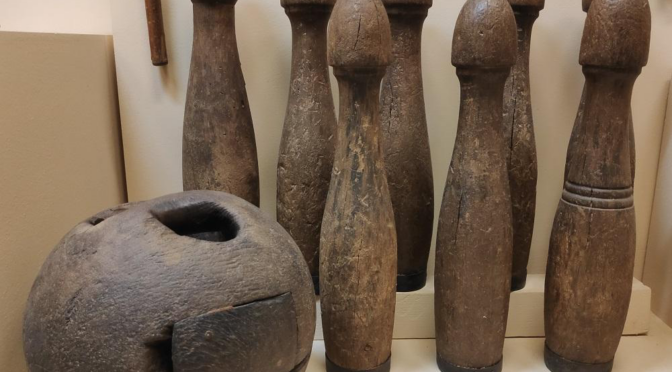
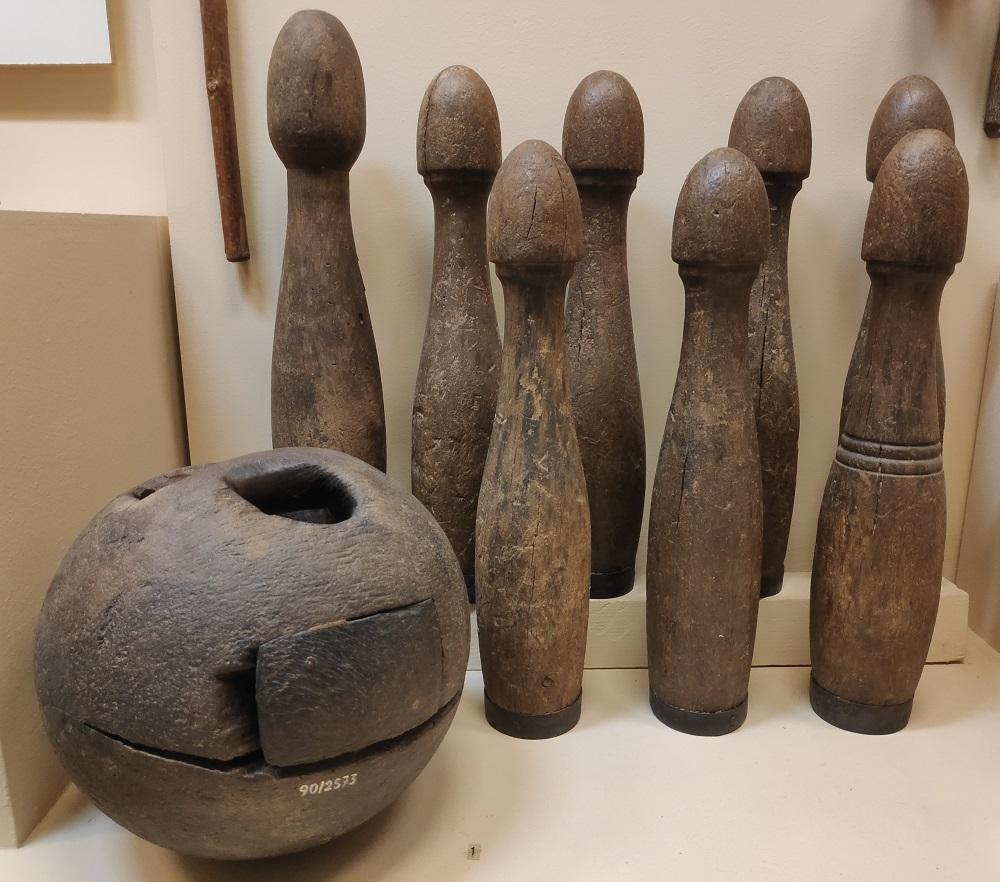
We were recently in Boise to celebrate my daughter’s high school graduation with her grandparents (Zorionak Rose!) and while there stopped by the Cyrus Jacobs/Uberuaga house – if you’ve never been there, it provides a great look into a Basque boarding house. In any case, there was a small exhibit on bola jokoa, or the Basque version of bowling (or skittles). Color me intrigued, I had to look a little deeper into the game.
Bola jokoa is one of the few rural sports that isn’t directly inspired by the labors of the farm or the sea. Instead, it is an ancient game, dating back to at least ancient Egypt. Likely, it was invented independently several times around the world. In the Basque Country, it was often played on Sundays after Mass.
Records attest to forms of bola jokoa being played at least since the Middle Ages in the Basque Country, though most of those mentions are negative, condemning the game. For example, in 1571, the city of Lekeitio banned bowling. Other places banned bowling in the streets or on certain feast days. However, the game was very popular and bowling alleys were common, often attached to sagardotegis or cider houses. The game also ignited passions. It was a popular betting sport and fights often broke out.
As might be expected, back then, while there were formal rules written, oftentimes they varied significantly from region to region. The types of bowling pins, the nature of the ball, and even the layout of the alleys were different. Similarly, lots of different names are used for the different elements of the game. The pins are called, amongst other names, txirlo, birlo, pirla, pirle, birla, brila, and txirla while the alley itself is called bolatoki, bolaleku, karrejo or boladera.
Over time, these different versions of bowling led to three modalities that are commonly played today. These are primarily classified according to the ball. The three-holed ball is much like what is found in bowling alleys across the United States with one hole for the thumb and two holes for fingers. The hand-holed balls have two holes, one for the thumb, and one for the rest of the fingers to fit into. And then there is a version with no holes, in which the ball is simply held.
It wasn’t until the 20th century that the rules started to become standardized, though versions without formal rules are still played all across the Basque Country. The first tournament in the Basque Country was held in Vitoria-Gasteiz in 1945; players from all over Araba participated.
The Euskal Herriko Bola Joko federazioa – or the Basque Country Bola Joko Federation – which was founded in 1986, officially recognizes 13 different variations of bola jokoa. Wikipedia lists some 28 versions played throughout the Basque Country. Not all of these are native to the Basque Country. Typically, only one type is played in a given place.
Today, the game, perhaps like bowling in the United States, is not as popular as it once was. It is only played on special occasions. And many bowling alleys have disappeared.
A full list of all of Buber’s Basque Facts of the Week can be found in the Archive.
Oiarzabal received his Doctorate of Political Science-Basque Studies from the University of Nevada, Reno. Over the last two decades, his work has focused on research and consulting on public policies (citizenship abroad and return), diasporas and new technologies, and social and historical memory (oral history, migration and exile), with special emphasis on the Basque case. He is a member of Eusko Ikaskuntza.
Tabernilla is a researcher and founder of the Sancho de Beurko Elkartea, a non-profit organization that studies the history of the Basques of both slopes of the Pyrenees in the Spanish Civil War and in World War II. Between 2008 and 2016 he directed the catalog of the “Iron Belt” for the Heritage Directorate of the Basque Government. He is author, along with Ander González, of Basque Fighters in World War II (Desperta Ferro, 2018).
In recent weeks, one family contacted Sancho de Beurko, a nonprofit historical association based in the Basque Country and responsible for the “Fighting Basques” research project, asking about relatives lost during World War II. Beyond a few names and fragmented recollections, very little about them had survived within the family over the decades.
What followed became an unexpected reminder of how the past can suddenly reappear years later — reconnecting people with stories, places, and lives that had slowly faded over time.
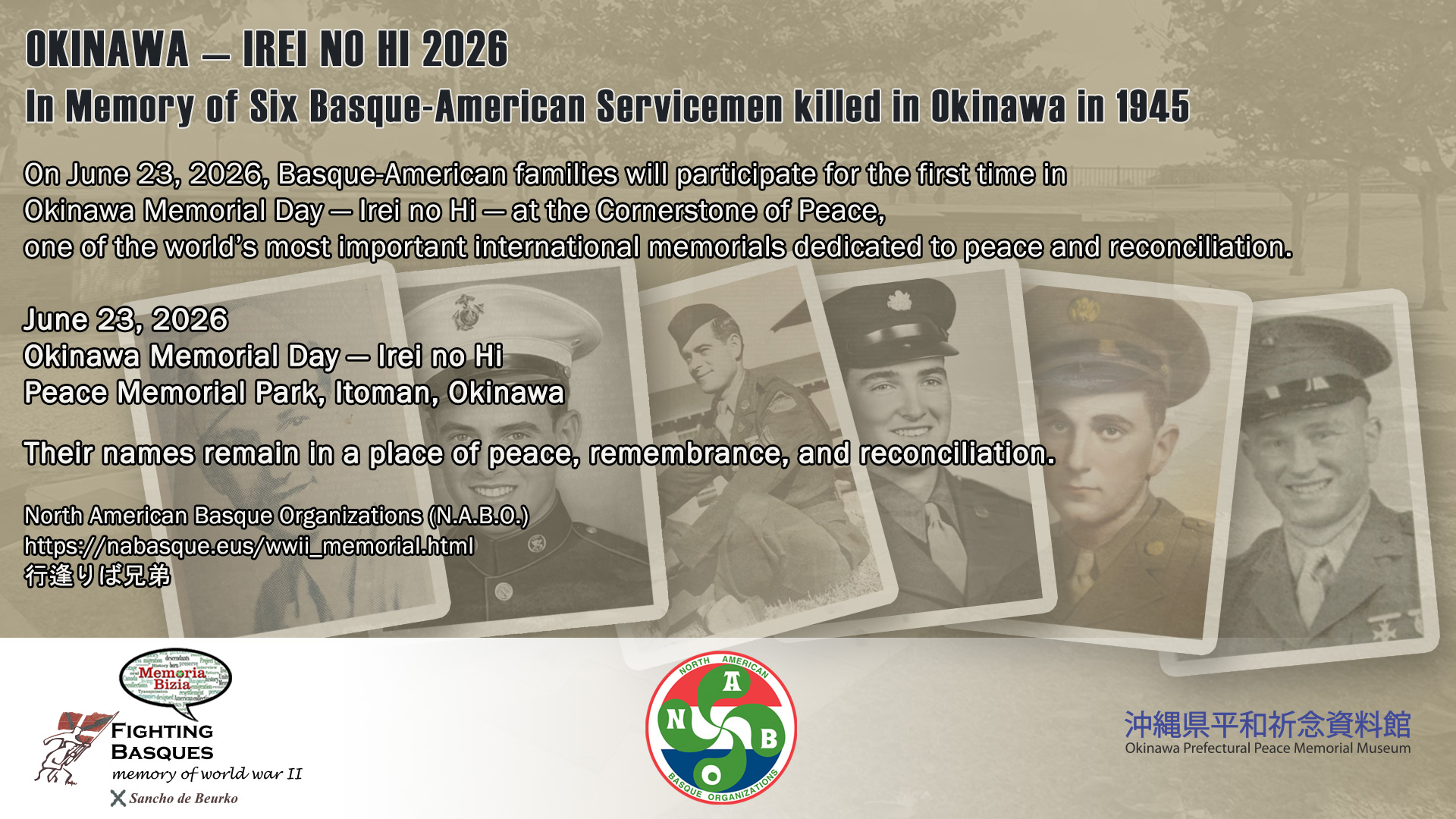
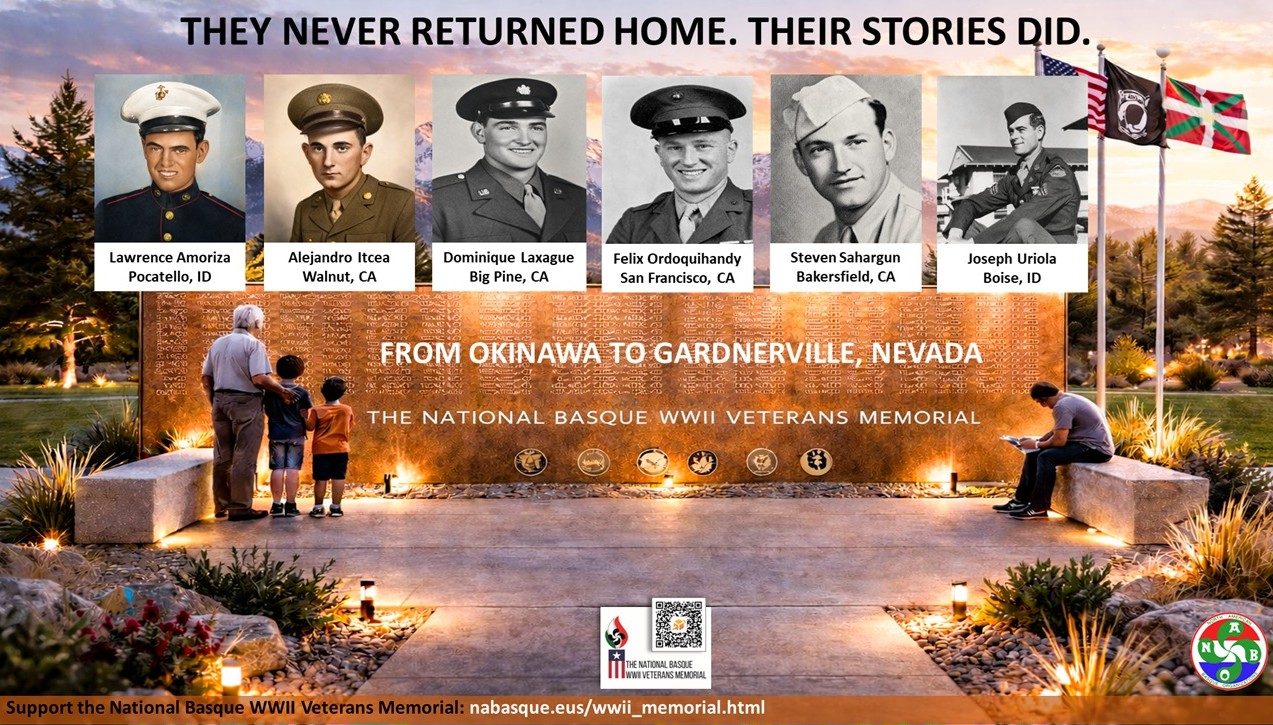
That same process will soon bring to Okinawa (Japan) relatives of six Basque-American servicemen who died during and after the Battle of Okinawa, who will participate for the first time in Okinawa Memorial Day — Irei no Hi (慰霊の日) — on June 23, 2026.
Dr. Pedro J. Oiarzabal, lead researcher of “Fighting Basques,” will attend on behalf of Sancho de Beurko Association and the North American Basque Organizations, Inc. (N.A.B.O.).
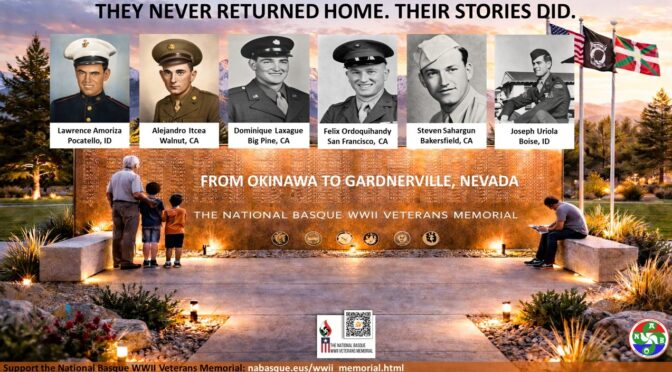
The six Basque-American servicemen connected to Okinawa were: Lawrence Amoriza, Alejandro Itcea, Dominique Laxague, Felix Ordoquihandy, Steven Sahargun, and Joseph Uriola.
Eighty-one years after the battle, the journey represents far more than a commemorative trip. For the families, it is a chance to visit the place where their relatives’ lives ended abruptly, bringing personal history into direct contact with one of the most important sites of remembrance and reconciliation associated with World War II.
Held annually at the Cornerstone of Peace, Irei no Hi commemorates the end of the Battle of Okinawa — the final major campaign of World War II and one of its deadliest — and honors more than 240,000 people who perished during the campaign, including over 14,000 Americans and at least 100,000 Okinawan civilians whose names are memorialized at the site.
From Remembrance to Human Connection
The origins of this journey go back to December 2023, when Dr. Pedro J. Oiarzabal traveled to Okinawa on behalf of Sancho de Beurko and N.A.B.O. to pay tribute to Basque-American soldiers who died in the Pacific Theater during World War II.
That initial visit, carried out within the framework of the “Fighting Basques: Memory of World War II” research project, marked the beginning of an ongoing relationship with the institutions connected to Okinawa’s Peace Memorial Park and the Cornerstone of Peace.
Over time, what began as an act of remembrance gradually evolved into something much broader and more human.
People reconnected with relatives whose stories had vanished. Forgotten personal histories resurfaced. New connections also emerged between Okinawa, the Basque Country, and the Basque-American diaspora.
As part of this ongoing work, one of the six servicemen, U.S. Marine Corps Corporal Felix Ordoquihandy, whose name was not yet included at the Cornerstone of Peace, will be formally inscribed ahead of the June 23 commemorations. In addition, the inscription of another serviceman, U.S. Army Private First Class Alejandro Itcea, will be updated to ensure that his name is accurately represented at the memorial.
This year’s participation in Irei no Hi will also mark the first formal Basque presence at one of the world’s most important annual commemorations dedicated to peace, remembrance, and reconciliation. During their stay in Okinawa, Dr. Oiarzabal will also participate in gatherings and conversations centered on diaspora, historical memory, and the human connections that continue to emerge more than eight decades after World War II.
Six Young Lives
They were not a group brought together by design, but by circumstance — and by war.
Lawrence Amoriza, Alejandro Itcea, Dominique Laxague, Felix Ordoquihandy, Steven Sahargun, and Joseph Uriola.
Six Basque-American soldiers whose lives ultimately converged in Okinawa.
Five of them were sons of Basque immigrants who had arrived in the United States in the early decades of the 20th century to build new lives in the American West. The sixth was a grandson of immigrants. Their families came from both sides of the Basque Country — Bizkaia and Nafarroa in the south, Nafarroa Beherea and Zuberoa in the north.
They grew up in California and Idaho, in farming communities, ranches, and small towns shaped by migration and hard work.
Four served in U.S. Army infantry units. Two were Marines of the 5th Regiment of the 1st Marine Division — one of the most heavily engaged units in the Pacific.
Some had already seen combat across the Pacific — from the Aleutians to Kwajalein, Leyte, Tarawa, and Saipan. Joseph Uriola, from Boise, Idaho, had already fought in multiple campaigns and was awarded the Bronze Star for saving the life of a fellow soldier. Steven Sahargun, from Bakersfield, California, had taken part in some of the most intense battles of the war before arriving in Okinawa.
Felix Ordoquihandy, a Marine from San Francisco, survived fierce combat in the Pacific, including Okinawa, but did not die in battle. Instead, he died in a tragic accident at sea after the fighting had ended. His body was never recovered.
Others, however, arrived in Okinawa with no prior combat experience.
Dominique Laxague, Lawrence Amoriza, and Alejandro Itcea were part of a replacement sent directly from training into one of the most brutal battlefields of World War II.
For them, Okinawa was their first battle.
And their last.
On average, they were just over 21 years old when they died.
Among them were Lawrence Amoriza and Alejandro Itcea — two of the youngest and least experienced, whose stories help us understand the lives behind these six names.
Lawrence Amoriza
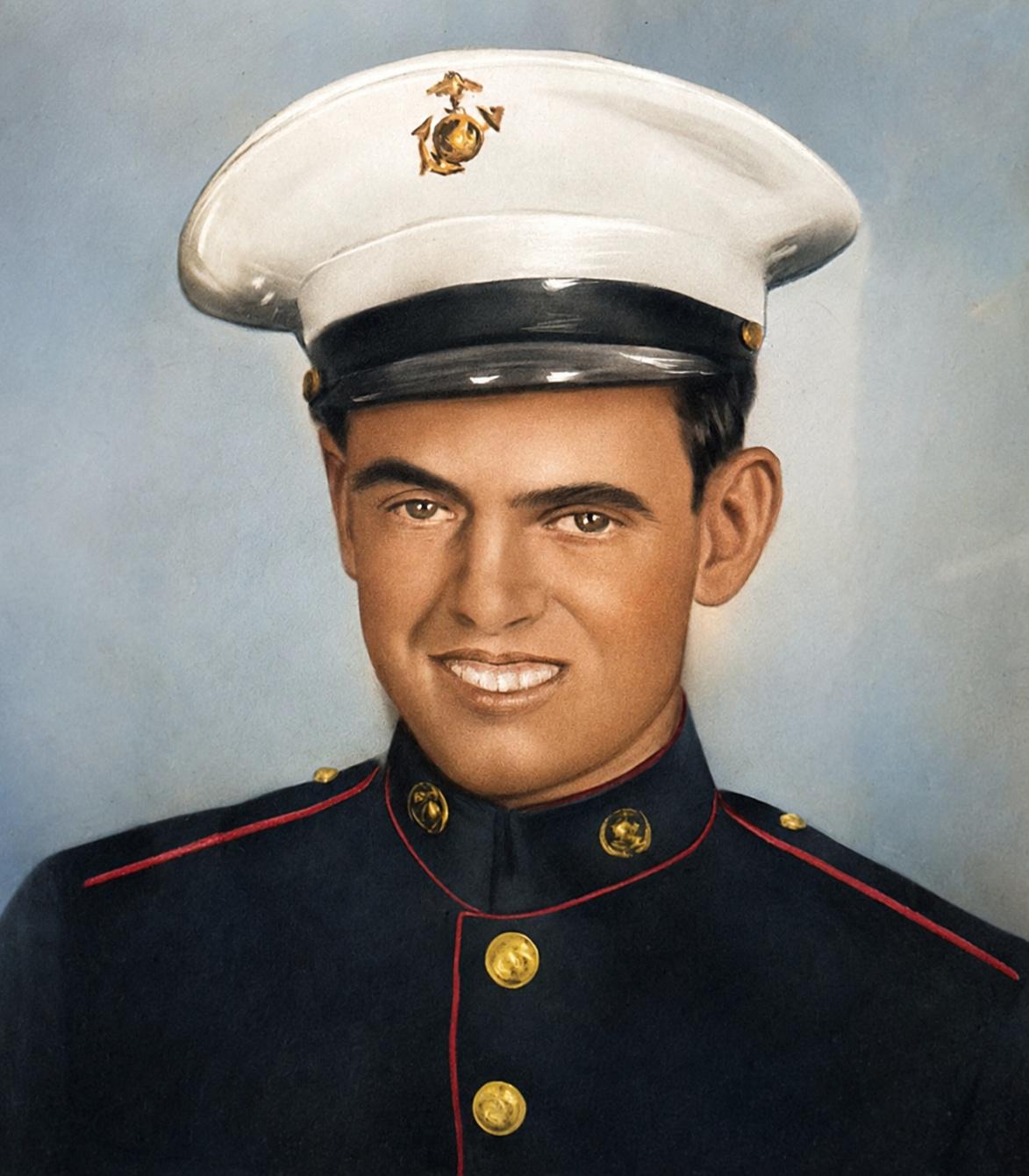
U.S. Marine Corps Private Lawrence Amoriza served with Company A, 1st Battalion, 5th Marine Regiment, 1st Marine Division. (Photo courtesy of the Amoriza family).
Lawrence Amoriza was born in 1925 in Pocatello, Idaho, to Basque immigrant parents from rural Bizkaia. His father, Tomás “Thomas” Amoriza Zubero, arrived in the United States in 1916 at the age of eighteen. His mother, Asunción Guerricagoitia Bengoechea, followed a few years later. Like many Basque families of that generation, they built their lives through agricultural labor — first as sheepherders, later as farm workers.
When Lawrence was still a child, his mother passed away. His father moved the family west to California, where they continued working the land.
By the early 1940s, Lawrence was already working alongside his father and siblings.
At 18, he was drafted into the U.S. Marine Corps. By April 1945, he was already in Okinawa, serving with the 1st Marine Division.
On May 1, 1945, Lawrence was killed in action while his unit was engaged in heavy fighting in the Awacha (Ahacha) Pocket, south of the town of Ahacha (安波茶).
He was 19 years old.
His brother, Thomas, had joined the U.S. Army Air Forces in 1943 and was honorably discharged in 1946. He would survive the war.
Alejandro Itcea
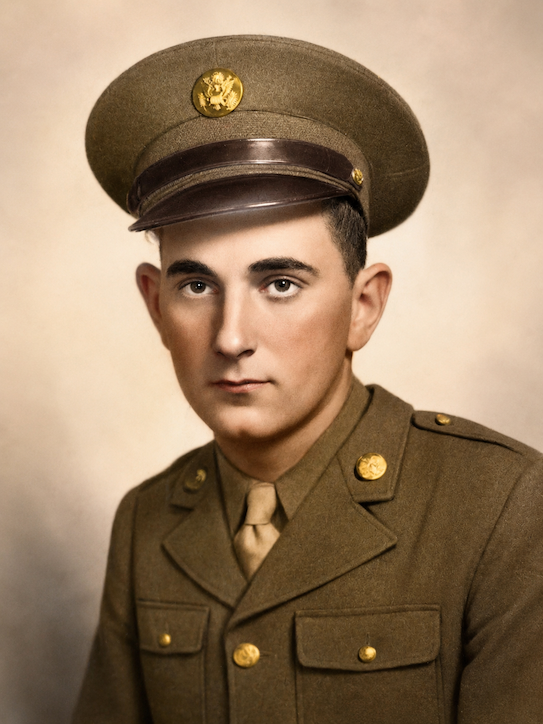
U.S. Army Private First Class Alejandro Itcea served with Company E, 306th Infantry, 77th Infantry Division. (Photo courtesy of the Itcea family).
Alejandro Itcea was born in 1922 in Walnut, California, to Basque immigrant parents from Nafarroa. His father, Pablo Itcea Ariztia, arrived in the United States in 1911. His mother, Paulina Zualet Ithurria, followed in 1920.
Alejandro grew up working on the family’s cattle ranch and barley farm. He graduated from La Puente High School in 1942. He was engaged, and like many others of his generation, his life was soon interrupted by war.
In 1944, Alejandro enlisted in the U.S. Army.
Soon after, he was sent overseas — first to Hawaii, then to Saipan, and finally to Okinawa.
On May 30, 1945, after being wounded in combat during prolonged fighting under harsh conditions, Alejandro died of his injuries.
He was 22 years old.
Alejandro was posthumously awarded the Bronze Star.
What Remains After Okinawa
What will take place in Okinawa this June is not simply a commemorative event tied to the past.
In many ways, it reflects something much deeper: the enduring human need to reconnect names with lives, families with their past, and history with the people who continue carrying those memories forward across generations.
For the relatives of these six Basque-American servicemen, the journey to Okinawa represents far more than a formal ceremony. It means standing in the place where their loved ones spent the final moments of their lives — transforming distant family stories into something tangible and profoundly personal.
But Okinawa also speaks to something larger.
Over the past decade, the “Fighting Basques: Memory of World War II” research project, developed by Sancho de Beurko and carried out in collaboration with N.A.B.O., has identified more than 2,160 men and women of Basque descent who served in the U.S. Armed Forces and Merchant Marine during World War II.
The six servicemen connected to Okinawa are part of that much broader history — one shaped by migration, war, sacrifice, family separation, survival, and remembrance over time.
In that sense, Okinawa is not an isolated chapter. It is part of a much longer process centered on recovering, preserving, and bringing visibility to personal histories that risk disappearing over the years.
Separated by thousands of miles, the Cornerstone of Peace in Okinawa and the future memorial in Gardnerville ultimately share the same essential purpose: ensuring that the lives behind war are never reduced to statistics, dates, or forgotten names.
As families prepare to gather in Okinawa in a few days, what remains most meaningful is perhaps not only the act of remembrance itself, but the realization that these stories continue to matter because they remain connected to real people and lived experiences.
Making the National Basque WWII Veterans Memorial a reality will ultimately depend on the continued support of families, organizations, institutions, and individuals committed to preserving the stories and legacy of this generation into the future.
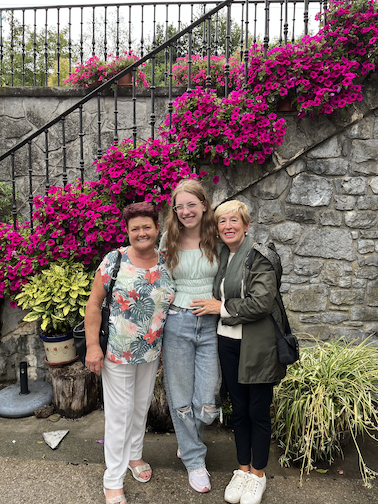
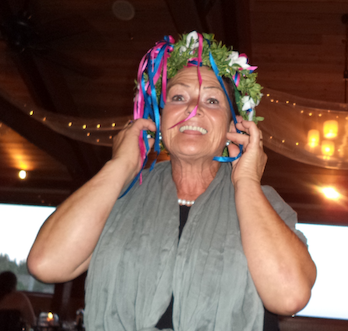
On Saturday, June 6, 2026, my dad’s sister Rosario Uberuaga Zabala died. She was on her balcony, tending her flowers, when she was struck by a heart attack.
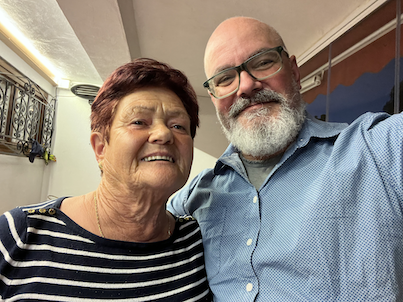
I first met Rosario in 1991, when I went to live in the Basque Country. Like most of dad’s family, I never knew her growing up. I was only vaguely aware she even existed. I think I’ve said this before, but in those days travel and even phone calls were too expensive and dad simply didn’t interact with this family much. And when he did it was always in Basque and always him maximizing his time talking with them. But, when I went to the Basque Country, I got to know Rosario and the rest of dad’s family, and they became a big part of my adult life. Over the now many years since I first met her, Rosario became one of the center pieces of what the Basque Country is for me.
All her life, Rosario worked and worked hard. When I first knew her, her husband had just died only a year before. She was a young widow that now had two young kids and a bar to manage. Nestled in the hills just outside of Amorebieta, Autzagane – the small barrio where her bar was – became one of my haunts. Rosario was always bustling, whether behind the bar or in the kitchen. In the same breath, she would bark a commanding order that showed she was in charge but flash a brief smile that revealed the kind and playful side that was always beneath the surface. She wasn’t a tall woman but her presence filled the room, demanding attention from everyone. Not being able to speak much Spanish and even less Basque, I often just sat in the dining room, which was always full of patrons, watching the embers in the massive fireplace that seemed perpetually lit as they shifted colors and threw off sparks. Many of my hours in the Basque Country were filled with waiting as others simply did their jobs and lived their lives, but it helped me build patience and be comfortable with myself and my own interior headspace.
Some years later, Rosario retired and threw a massive party to celebrate closing the bar. There was a band and literally hundreds of people who came to honor and celebrate Rosario. Next to the bar, she had been able to build two chalets, a testament to her hard work and the success she had achieved. But, just because she had retired, she never stopped working. When her mom – my amuma – couldn’t live on her own at the family baserri, she went to live with Rosario. And so did Tio Joe, when he also needed extra help. Rosario was the rock of the family. She became the one who took in the elders of the family, and watched over them. And sometimes they acted more like children than adults. She had to act the mother for Tio Joe, who was climbing ladders and trimming shrubs at the age of 90 like he was 20 or 30 years younger. But she made him feel at home, where he could tend the chickens and rabbits and keep his hands dirty.
All those years of working on her feet, of being there for everyone else, certainly took their toll. She had her aches and pains, but she hid them, always putting others first. She was always thinking of everyone else. One trip, we stayed at her place which had these cold tiles decorating the main living space. Lisa was walking around with socks and got an earful that she would get sick because she didn’t have her slippers on. Socks were simply not enough. She was so concerned that Lisa would get sick that she kept badgering her until Lisa caved and wore some house slippers. As we sat in her dining room at the end of the day, she pulled out a simple treat – bread and chocolate – and opened a whole new world of dessert for us. That little treat was almost a mirror of Rosario – a simple, rough exterior that hid so much goodness.
Rosario always had this gruff demeanor but there was always a twinkle behind her eyes. She was always teasing me – always throwing broncas – particularly when my Spanish didn’t quite convey what I intended. But there was always that twinkle that betrayed the immense heart and kindness that lay behind her rough exterior. In many ways, she was a reflection of my dad – someone who had always worked hard to the detriment of their own health but who was always there for everyone else.
Rosario was 77. My Basque Country will not be the same without her.