A while ago, I wrote about Jon Bilbao and his pioneering work Amerikanuak. Richard Etulain has just published Basques of the American West, which brings new perspectives to the Basques that helped shape the history of the western United States. It also explores newer topics such as the history of Basques in places such as Washington state.
Basques of the American West New and Collected Essays on History and Ethnicity
Richard W. Etulain
DESCRIPTION
Basques of the American West: New and Collected Essays on History and Ethnicity brings together new and previously published work by Richard W. Etulain, blending historical analysis and literary criticism to explore the lives, stories, and representations of the Basques in this region. The essays examine key figures such as Robert Laxalt and Frank Bergon; survey historical studies, memoirs, and novels; and trace evolving interpretations of Basque identity in Western literature and scholarship. Etulain highlights major trends in both Basque and Western American historiography while identifying important topics that remain open for additional research.
This collection offers readers a thoughtful and engaging look at the enduring presence and influence of Basques across the cultural and historical landscape of the American West.
AUTHOR/EDITOR BIOGRAPHY
Richard W. Etulain, PhD, is professor emeritus of history at the University of New Mexico. He studied at Northwest Nazarene College in Idaho and received his graduate degrees from the University of Oregon. He was a Fulbright Lecturer in Ukraine and taught at the University of the Basque Country. Etulain is an author or editor of more than sixty books and has served as the president of both the Western History and Western Literature Associations.
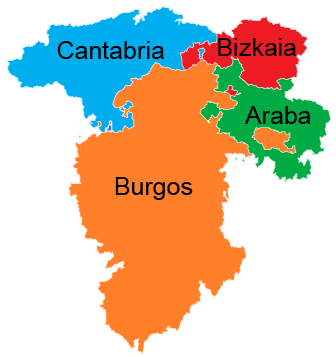
Back in March, we took a quick trip to the Basque Country to see family. On the way, we had stopped at Burgos, just to see a new place. We were talking about Burgos when a friend said he had passed through Burgos when he participated in Korrika, the massive race in support of the Basque language. At first, we were a little confused – why would Korrika pass through Burgos – until they pointed out the big hole in the middle of Araba…
Let’s start with some definitions. An enclave is a territory belonging to one jurisdiction that is surrounded by an other. An exclave is the opposite – it is a piece of territory that is separated from the main jurisdiction. So, an enclave of one place can be an exclave of another.
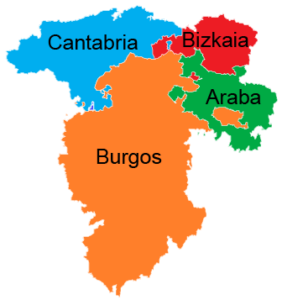
The “hole” in Araba is the Treviño enclave. It is actual part of the province of Burgos, but it is surrounded by the province of Araba. It consists of two municipalities, Condado de Treviño and La Puebla de Arganzón. Puebla de Arganzón was founded (received its fueros) in 1191 from Sancho VI of Navarre (“Sancho el Sabio”, “Sancho the Wise”) in 1191. It is thought that Condado de Treviño is even older. When Araba was conquered by Castilla, the region that now forms the Treviño enclave was given to Manrique family and passed down as part of a noble title.
As one might expect, this has led to both some complications and challenges. The people of the enclave must travel to Vitoria-Gasteiz, the capital of Araba, for many of their services. This creates a strange administration problem in which Araba provides the bulk of the services to the people of another province.
The people of the enclave have voted in the past to join Araba, but that vote was ignored. More recently, there have been votes to have a referendum on the issue, but that was also ignored. The current leaders of the enclave have deferred the discussion to higher level government officials.
Araba isn’t the only Basque province with an enclave. Bizkaia also has one, this one belonging to the province of Cantabria. Valle de Villaverde was purchased in the 15th century by one Pedro Fernández de Velasco, and at that time it ceased being a part of Bizkaia.
And, Bizkaia has an exclave. The city of Urduña is part of Bizkaia, but it sits on the border between Araba and Burgos – it is not an enclave as it is not surrounded by a single other territory, it is on the border. It has strong historical ties to Bizkaia with long standing economic agreements and commercial routes connecting to Bizkaia. Though Araba has tried to annex it in the past, the people of Urduña have reaffirmed their commitment to remain part of Bizkaia.
…AND, within Urduña there is yet another enclave. The Cerca de Villaño sits within the Urduña exclave but is part of Burgos.
A full list of all of Buber’s Basque Facts of the Week can be found in the Archive.
Primary sources: See the links in the main article.
Unfortunately, Buber’s Basque Page was down for a few days due to a compromised server, which meant that some posts have been lost. My most recent backup dates to December, 2024, so I’ve lost about 1.5 years of posts. I’ll slowly work to replace those posts as I continue to add new content, but it will take me some time.
If you recently sent me an email or had a message that was awaiting a response from me, I likely don’t have it anymore, so feel free to write me again.
And, if you recently subscribed to the blog, you might have to subscribe again to continue to receive posts via email.
My apologies for this. Clearly, I should backup more often than I do (isn’t that what we all say???). I appreciate your patience as I slowly recover the posts that have been lost.
Joxe Mallea-Olaetxe, a long-time friend, is a historian who has worked tirelessly to document the history of Basques in the American West. One very visible example is his work on the arboglyphs Basque sheepherders left behind as they roamed the hills, valleys, and mountains of states such as Nevada, Idaho, and Oregon, but he has done much more. But, as with any attempt to document history, there are always holes that can’t be filled through evidence alone, and that is particularly acute for any and all things Basque. Thus, Joxe has turned to fiction to fill that void, rooted in his long years of study. Below is a trailer for his first novel.
Language Speaks Louder Than Bones: The Story of The Basques Naming Themselves, ca. 500,000 BP A Trailer by Joxe Mallea-Olaetxe
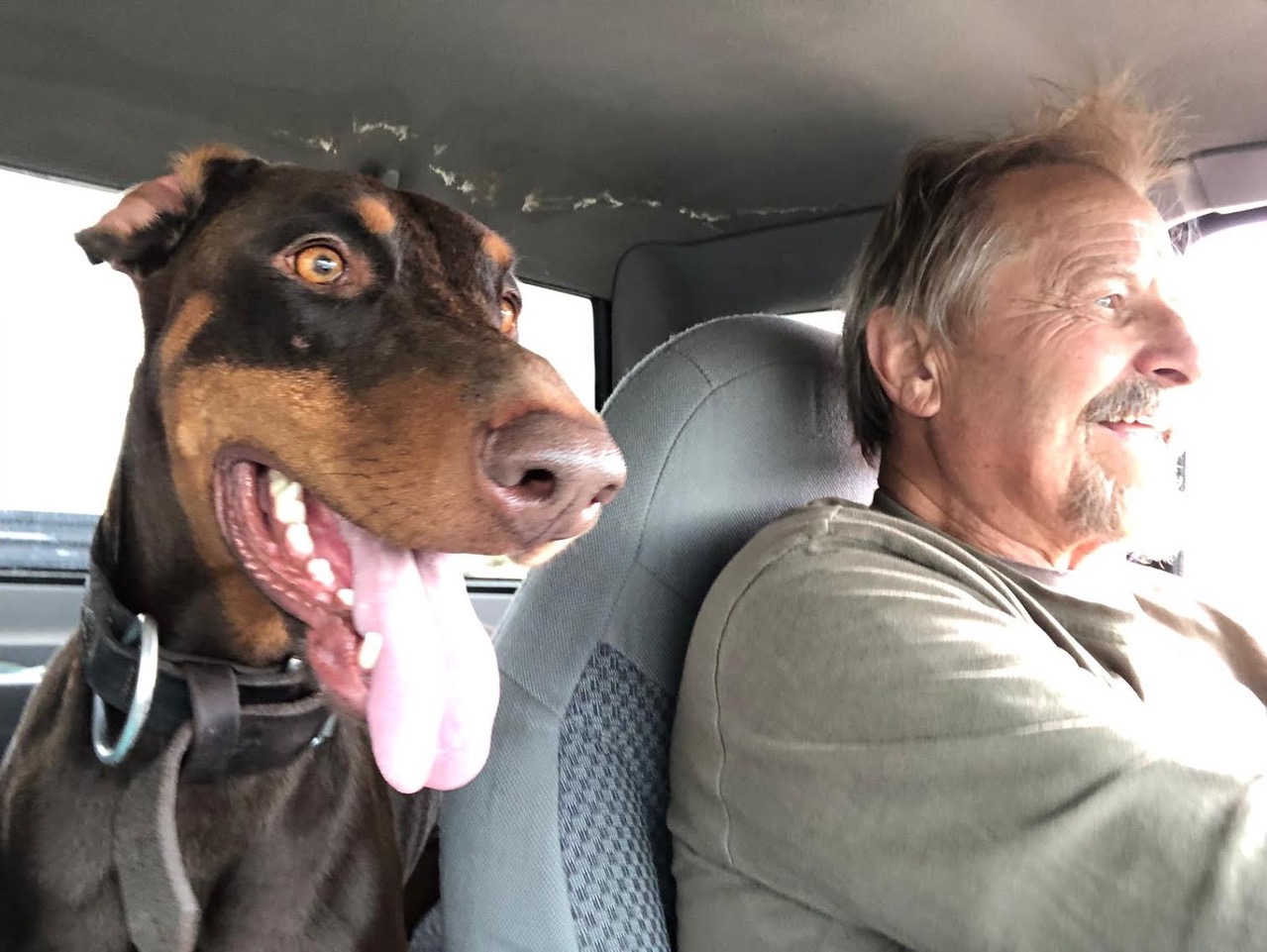
Joxe with his daughter’s doberman Zoe as they go for a hike. Photo by Nikane Mallea.
Most of my life I have been a historian and a history-writer, until recently when I embarked in a new career as a fiction writer. I am young enough to undertake it, because writing fiction is less taxing than historical research. Besides, Saint Augustin says that fiction is another aspect of history, therefore I am not running away from it.
I am also a linguist, and though I do not have a proper university degree in linguistics, I have taught several languages at the university and college level.
My first novel is finished. It is not your run-of-the-mill novel that happens tomorrow or a century ago. Action is set ca. 500,000 BP.
What,? you might say; What do you know about life half a million years ago? Not much, but that’s the point. Is there anyone else who knows much about it? A lot has been written about our cave-dwelling ancestors, but the evidence comes from a few old bones and stone tools. The discovery of a new bone is enough to trigger someone to write a book demolishing all we thought we knew before.
I find it curious that no scientist ever attempted to use language to gaze into our deep past. Perhaps nobody thought that their language had any value, which might as well be true, but Euskara, the language of the Basques, does.
Appropriately, the title of the novel is Language Speaks Louder than Bones.
I am the narrator and thus an eye witness, which means I am there where the actions is. By the time I am done with the novel, I — and you — will probably know more than anyone about the cave dwellers. There are some — many — holes in my narrative, it happened so suddenly. I don’t know how but I found myself on a tree watching below a group of pre-Neanderthal hunters, or bears? At first I thought they were bears, until I realized that they were holding spears. Do bears hold spears?
I have still no idea where I was, but certainly somewhere in the Atlantic Europe. The huge discovery was that the dozen or so clans that I came into contact with, had some proto-Euskara words in their languages. The next finding was that these clans lived at considerable distance from each other, but they could communicate, because their languages shared some common basic words, of which some sounded like Basque.
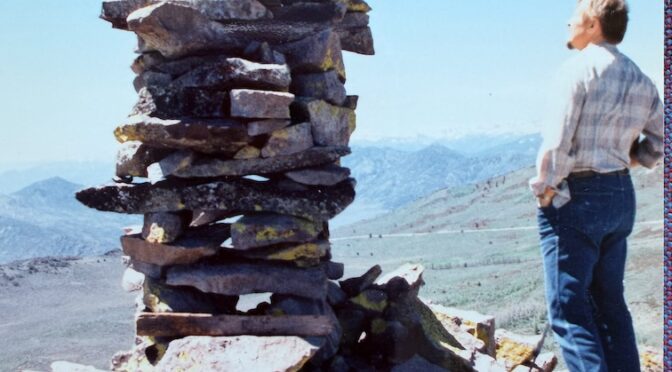
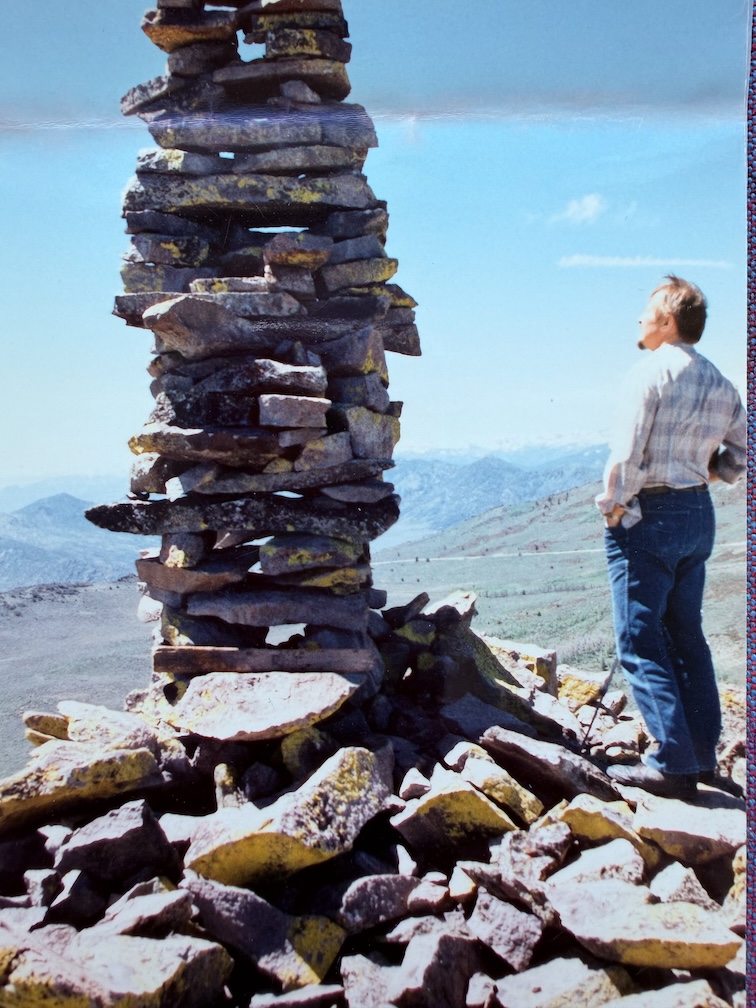
A monumental harrimutil (stone cairn) erected by sheepherders in Alpine County, CA.
The Basque language, Euskara, has words that literally take us back to the time when “gize” (humans) had four hands, so before they embarked their bipedal journey.
The gist of the novel is that I was at the meeting when eight clans came together to choose a common name for themselves. In fact, they ended up selecting two names, one picked by the men and one preferred by women.
It did not happen overnight. It came after the realization that they, the cave dwellers, were not any different from bears, but had some differences, for example, making tools and building a fire, something they didn’t see other animals do, in fact, all animals avoided fire. The other monumental discovery was the language, so let no one call them primitive or brutes anymore.
I haven’t decided where or how I want to publish; I may end up going the Kindle way.
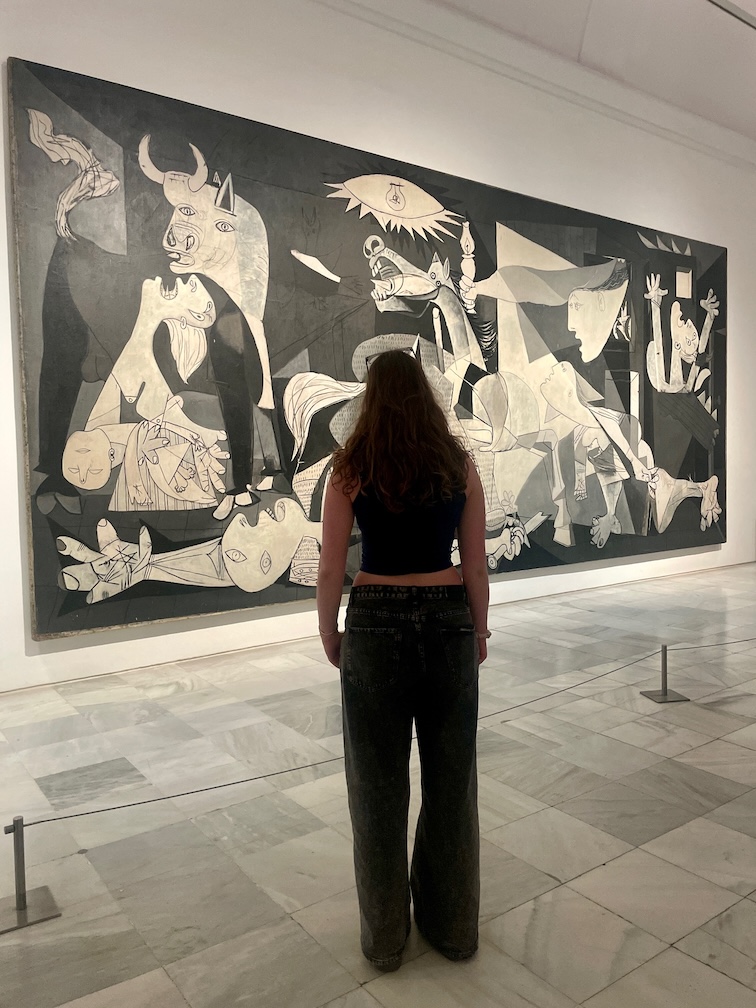
Today marks the 89th anniversary of the bombing of Gernika. Last month, in March, we made a quick trip to the Basque Country over spring break to visit my dad’s family and made of point of seeing Picasso’s Guernica. As we near the 90th anniversary of the bombing, the painting is once again in the news as the Basque government has requested that the painting be loaned to the Basque Country. This request has been denied, based on arguments that the painting is too fragile.
My daughter Rose contemplating Picasso’s Guernica. Photo taken by Lisa Van De Graaff.
Gernika sits at a crossroads, centrally located between the cities of Lekeitio, Nabarniz, Markina, Amorebieta, and Mungia and Bermeo. Every Monday, the city hosted a market and fair which would draw residents of nearby towns; more than 10,000 people typically attended the market. There were few military targets in Gernika: the bridge and the arms factory.
At 4:30pm on April 26, 1937 – a Monday – planes from the German Condor Legion and the Italian Air Force began bombing the city. George Steer, a journalist who arrived in Gernika the day after the bombing, took accounts from the survivors and sent the first account of the bombing to the international press.
Some air raid shelters had been established as a response to the bombing of Durango only about a month before. As church bells pealed out a warning of an air raid, people fled to find shelter, leaving their livestock in the market square. Two planes flew over and dropped bombs and incendiary devices. As the aircraft flew overhead, machine-gun fire strafed the people running in the streets.
After that, nothing happened for about 15 minutes and the people began emerging from their shelters when another group of bombers flew overhead, dropping more bombs that then exploded. The streets filled with fire and smoke. Some of these bombs were one thousand pounds and penetrated through buildings and into basements and shelters. As the panicked populace again emptied to the streets to flee, more planes strafed them with more machine-gun fire.
This continued until about 7:30pm, by which time nearly the entire city was ablaze. The Church of San Juan had a hole in its roof where a bomb had penetrated, setting the altar ablaze.
The immediate aftermath of the bombing was a series of denials and accusations from both Franco and the German government. While they acknowledged that Gernika had been a military target, poor visibility led to some stray bombs that hit the city itself and that then the Basque “Reds” deliberately set the city ablaze. However, the discovery of Wolfram von Richthofen‘s diary (von Richtofen was commander of the Condor Legion), which were made public in the 1970s, confirmed the bombing and the tactics used. At the Nuremberg trials, Herman Göring said that Gernika was “a sort of test bed for the Luftwaffe” and that it was an experiment that “could not be conducted anywhere else.”
The plans to bomb Gernika, while gestating for some time, were finalized in a meeting the day before, on April 25, in Burgos. It is hard to know precisely who was involved, but at least Richthofen and the Spanish fascist leaders Juan Vigón, Emilio Mola and Franco were involved in the planning. Richthofen and Italian general Vellani were at the Burgos meeting, though Mola was elsewhere.
The number of people who died in the attacks is hard to pinpoint as there are many figures out there, but they range from a minimum of 153 to more than 1500. Xabier Irujo’s analysis points to the higher number, or even more than 2000 dead. The bombing received international attention as it was one of the first aerial bombardments of a civilian population. However, it wasn’t the first: several Basque towns had been bombed earlier in the war, including Munitibar and Durango.
A full list of all of Buber’s Basque Facts of the Week can be found in the Archive.
While Athletic Bilbao receives more international attention, primarily due to their unique policy of signing only Basque players, they are not the only team in the Basque Country – there are several. Yesterday, April 18, 2026, the soccer team from Donostia, Real Sociedad de Fútbol, won the Copa del Rey, their first win since 2000 and only their fourth win in their history. Star player Mikel Oyarzabal scored one of their goals, with rising star Ander Barrenetxea scoring the other. Led by an American-born coach, this win caps a remarkable turnaround where they were almost relegated to second division only a year ago.
The players of Real Sociedad celebrating their Copa del Rey win against Atletico Madrid on August 18, 2026. Photo from Reuters.
Fútbol came relatively late to Donostia – the first recorded match was played in 1902, a time when other towns in Gipuzkoa already playing. The sport was brought over from England, by young men who had worked or studied there. By 1903, the first clubs had been established.
To formally compete in official championships, clubs had to be registered. One club in Donostia registered under the name Club Ciclista so that they could play in the 1909 Spanish Championship, the Copa del Rey, which they won. This team ultimately became Real Sociedad. In 1909, they formed their own team, the Society of Football, and in 1910 the Spanish king bestowed the title “Real”, or Royal. Hence, they became known as Real Sociedad de Fútbol, the Royal Society of Football.
In 1913, the city and team inaugurated their football field, Atotxa, which became their home for over 80 years. The first match in the new stadium as against Athletic Bilbao, a game that ended in a 3-3 tie. In 1993, the team moved to their current stadium, Anoeta.
Real Sociedad was one of the founding teams of the Spanish La Liga in 1929. In 1931, they briefly changed their name to the Donostia Club de Futbol during the Second Spanish Republic, but after the Spanish Civil War they reverted back to Real Sociedad de Futbol. Their nicknames in Basque are Erreala (“Royal”) and the txuri-urdin (“white-blue”).
Since their founding, Real Sociedad has won the Copa del Rey four times, including that first year in 1909 and most recently just yesterday – April 18, 2026. The previous win was in 2020, when they beat Athletic Bilbao for the win after a year delay due to COVID. They have also won the Spanish Premier League twice, most recently during the 1981-82 season.
Up until 1989, Real Sociedad maintained a policy similar to Athletic Bilbao in that they only signed Basque players. However, in that year, they signed forward John Aldridge from Ireland.
Real Sociedad is more than a men’s soccer team. They also consist of track and field, field hockey, and pelota. In 2004, the group formed a women’s soccer team, Real Sociedad Feminino. That team won the Copa de la Reina in 2019.
Their current coach, Pellegrino Matarazzo, was born in the United States to Italian immigrant parents. Though obtaining a degree in applied math from Columbia, his passion was soccer. After a less than stellar career as a player, he became a coach and in December, 2025, he was named Real Sociedad’s coach. Real’s winning of the Copa del Rey is his crowning achievement. Just last year, the team was on the verge of being relegated to second division.
A full list of all of Buber’s Basque Facts of the Week can be found in the Archive.
Last year, the pioneering work Amerikanuak celebrated its 50th anniversary. Written by Willian Douglass and Jon Bilbao back in 1975, this book surveys the history of Basques in the Americas – not just the United States but all of North and South America. Bilbao had spent many years chronically all works written about the Basques which undoubtedly served as a foundation for Amerikanuak. Bilbao lived a complex life, bouncing back and forth between the United States and Europe as political tides ebbed and flowed. Studies of Basques in the Americas owe a great debt to Bilbao.
Jon Manuel Bilbao Azkarreta was born on October 31, 1914 in Puerto Rico. His father Juan had left the Basque Country at the age of 12 looking for opportunity. There Juan met Matilde Azkarreta. In 1917, the family moved back to the Basque Country, where Jon grew up. He got a bachelor’s degree from the University of Valladolid and then studied Medieval History at the Central University of Madrid.
He had intentions of returning to Bilbo where there were plans to open a Basque university but the Spanish Civil War broke out and he joined the Eusko Gudarosteak (Basque Battalions). The day Bilbo fell, Jon escaped in the dead of night to France, making his way back to Puerto Rico. He eventually enrolled in Harvard, then Columbia, then the University of California, Berkeley, to continue his doctoral studies. However, he never finished.
As a a deputy director of the “Basque Government in Exile” he was sent to Idaho to research the Basques there and to fund-raise for the government. During this time, he was very active in fight against fascism and, after World War II, was named a Knight of the Belgian Order of the Crown. In 1943, he became as citizen of the United States.
During these years, he began work on what would become Eusko Bibliographia, a reference documenting every item ever published on Basque topics. In the end, it took him 20 years to complete this monumental task. At a time before the internet where finding scholarly resources was challenging, this work was indispensable for Basque scholars.
He returned to the Basque Country for a few years, working with J.M. Barandiaran, before moving next to Cuba and then back to the Basque Country. In 1958, he was arrested by Franco’s government. He wasn’t imprisoned due to his American citizenship but was expelled from Spain. Moving to Biarritz, he was soon expelled by the French government, causing him to return to the United States.
He taught at Georgetown University and the Naval Academy before being recruited by William Douglass to join the new Basque Studies program at the University of Nevada, Reno. With Douglass, he toured Latin America and wrote Amerikanuak: Basques in the New World, the definitive history of Basques in the western hemisphere.
He retired from Reno in 1980 and returned to the Basque Country once again. He was excited by a number of projects related to the Basques, the diaspora, and the creation of a Basque library, but things didn’t quite materialize as he hoped. He died on May 23, 1994 after suffering multiple strokes.
A full list of all of Buber’s Basque Facts of the Week can be found in the Archive.
The medieval history of the Basque Country is both fascinating and so convoluted. There are so many marriages back and forth between different families as royals tried to consolidate and expand power that it becomes dizzying. A great example is Tota, or Toda, Aznar of Pamplona. Her skill as a diplomat and in establishing power through marrying her children places her as a central figure in the history of the Basque Country.
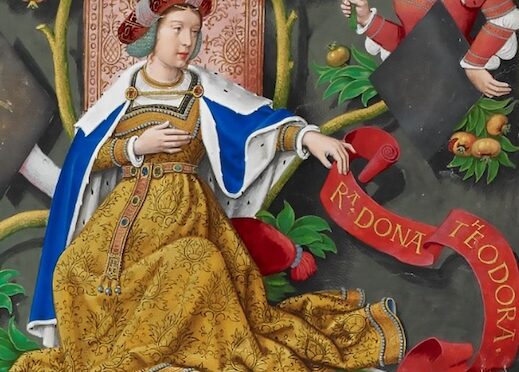
Toda de Pamplona, as painted by António de Holanda in 1530. Image from Wikidata.
Tota Aznar, or Toda as she was more commonly called, was born in the 9th century – possibly on January 2, 876. She was born into nobility. Her father was Don Aznar Sánchez, Lord of Latraun, and her mother was Doña Oneka. She was the granddaughter of King Fortuño Garcés “the Monk”; as such, she belonged to the Arista dynasty.
She married Sancho I of Pamplona, Sancho Garcés, who was of the Ximena dynasty. Thus their marriage united the two most powerful families of Pamplona.
Toda was a very skilled diplomat. As one example, she arranged the marriage of her daughter Sancha first to Ordoño II of Asturias. When he died, she arranged the marriage of Sancha with Álvaro Harrameliz, and after he died, with Fernán González, the Count of Castile, bringing the County of Álava as her dowry. She arranged similar marriages for her other daughters, solidifying the position and power of her family.
Sancho I died in 925. His brother, Ximeno Garcés (who also was Toda’s sister Sancha’s husband), succeeded him, but also became the guardian of Sancho and Toda’s son García Sánchez I. Ximeno didn’t last long, dying in 931, at which point García became king, but since he was still a minor, Toda became regent and his guardian.
The royalty of Pamplona was intertwined with the nearby Muslim rules (Toda was aunt or, more likely cousin, to Caliph Abd-al-Rahman III). In 934, Toda signed a treaty with Abd-al-Rahman III, which helped to cement the rule of her son, but by 937 Toda had already broken her treaty, leading to conflict. In 939, she is noted as having defeated “an innumerable army of Saracens,” saving the king.
After García rose to the throne in his own right, Toda becomes less prominent in records. However, by 958 she is noted as ruling her own subkingdom in the areas of Deio and Lizarrara.
Her last great feat as a powerful ruler was promoting her grandson, Sancho I of León, known as Sancho the Fat. She enlisted the aid of Abd-ar-Rahman III to cure Sancho’s obesity, which his Jewish physician Hasdai ibn Shaprut said he would do if Toda visited Córdoba, the seat of Abd-ar-Rahman’s power. She did, along with her son and grandson, and this visit proved to be a huge diplomatic event. Sancho was cured and went on to reclaim the throne of León.
A full list of all of Buber’s Basque Facts of the Week can be found in the Archive.
For centuries, the history of the Basques has been written by non-Basques – we have so little historical documentation written directly in Euskara or even by Basque themselves. Thus, when we find any hint of Basque history written by Basques, we must examine it to the fullest. The unassuming carvings left by Basque sheepherders in the American west might seem quaint or even cartoonish, but historian Prof. Joxe Mallea-Olaetxe has spent his career documenting those carvings to learn as much as we can about the people and circumstances that led to those carvings. Joxe took a winding route to his eventual calling, much like the sheepherders wandered those mountains. In this interview, Joxe discusses how he became a historian, the importance and meaning of the Basque tree carvings, and his new project to further spread and preserve those carvings and his work.
Buber’s Basque Page: Tell us a little bit about yourself. How did you find your way to the United States?
Joxe Mallea-Olaetxe: I was born in the MontorZuri farmstead [baserri] in Munitibar, Bizkay, Euskal Herria (Basque Country). The farm sits on a hill and from there, everything is steeply downhill. As a boy I am told that I used to throw down the hill anything that rolled, including my father’s cider barrel. By age 5 I was walking the cows to pasture, and I also started school, and on the first day the teacher told me something like “From now on you don’t speak Basque, only Spanish.” I didn’t understand a word, but later I learned what he meant.
I had an uncle priest, Luis Mallea, a renowned musician who in 1939 founded the Lagun Onak Choir (still singing) in Buenos Aires, Argentina. He told my parents that I needed to go to school and at age 9 they sent me to Onati to the monastery of the Canons of Lateran; the town called the priests “Agustiñuak,” and many local boys went to school there, which was located 9 kms from the better-known Franciscan Monastery of Arantzazu.
We were all Basques, except one or two “erdeldunak” (non-Basque speakers), but the official language was Spanish; after all, those were the Franco years. I was 16-17 when I discovered the Basque language and its dire situation, thanks to older members of the seminarians who were beginning to study and write in Basque; this was in the late 1950s. When I graduated in 1964, we were publishing Erein (To Sow), a periodical, all in Euskara, though some of our superiors were not too happy.
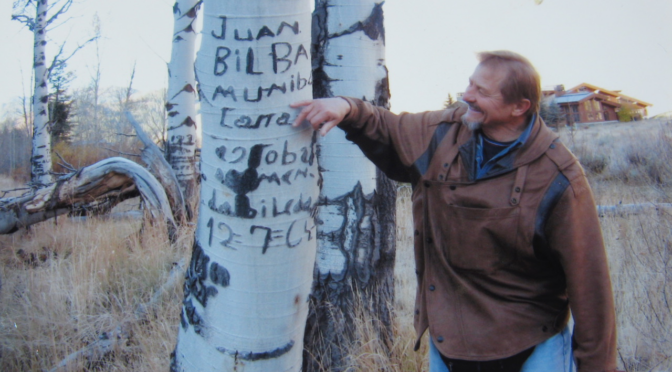
This comes from near Sun Valley, Idaho and it says “Juan Bilbao Munitibartarra asto bat emen dabilena, 12-7-1964.” In the photo you can see new homes encroaching on the old sheep range.
By that time, I was active in the Basque-language world (it was so small, anyway), and the Spanish police was keeping track of us. We learned many languages in the seminary, Latin, French, Spanish, classical Greek (on the first day of class I told the teacher I had no time to study a dead language and that he should give me a zero right then and there; he did at the end of the semester), and even some English. On my own I studied a little German and more English, and because of that I was sent to New York where a group of the Canons had already been engaged by the Archbishop to minister to the Puerto Ricans. At that time, the Catholic clergy in New York had few if any members who spoke Spanish. I was there three years, until one night I was robbed by a group (of teenagers, I think, but it was dark) and to me that was the chance to get away from the Big Apple and head to Nevada where my sister and other relatives lived. I also had an uncle in Modesto, California, and several cousins in California and Nevada.
I worked three years in the Church, first in Sparks, Nevada, and then Elko until 1971. I fell in love with Elko, where there were many Basque sheepherders and others. I had a terrific chance to start writing their history then, but I didn’t, though I interviewed some old-timers and kept the notes and a few photos. However, I redeemed myself several years ago when I approached the Basques of Elko about writing their history, which the University of Nevada Press will publish in the Spring of 2025. The title is: More than Sheepherders: The American Basques of Elko County, Nevada. It was a collaborative effort, Jess Lopategui being a major source, and two local women, Anita Anacabe and Mercedes Mendive, each writing a chapter.
BBP: My uncle Martin also studied to be a priest in Onati, and very nearly became ordained until he met his future wife. Was there a specific event that diverted you from the priestly path to that of the historian?
Joxe Mallea-Olaetxe: I studied theology for four years, 1960-64, and those were the years of the Vatican II Ecumenical Council, 1962-65, that Pope John XXIII heralded as a breath of fresh air that the Catholic Church sorely needed. Indeed, but the dissenters claimed that a lot of crows flew in through that window that the Pope opened (crows are asking, why blame us?). I lived and graduated through those ideologically and theologically turbulent years.
The best example I can point out is the Latin Mass that was replaced by local languages. Our theology textbooks were in Latin, and we started objecting why a dead language was so important. There were many aspects of our education that were outdated, and we young guns were eager to trample on them. One egregious example was “Don’t look at women.” You are asking that of a 20-year-old? It was very abnormal, and yet we were committed to the vow of chastity.
Intellectually and dogmatically speaking, the Church hierarchy in the 1960s was living four centuries back, when Inigo Loiola founded the Jesuits. The church resisted change as a policy, and we can understand why. If for centuries you were saying that Mary was “covered” by the Holy Spirit and she was a virgin when she gave birth to Jesus, that’s a tough one to prove, but you have to stick to it and continue preaching it. There is a canon law dictating that the Church and the Pope cannot err when it comes to religion. In other words, the Church wants its Catholics to not ask any question and live forever in a bubble, but sooner or later, the bubble can burst.
There is a positive side to resisting change; it gives people an anchor that they can depend on, and many people who prefer to let others do the thinking need it. The Church possesses other virtues such as assisting the poor and the hungry, the number one mission that Jesus commanded, but human beings, not saints, make up the Church and the hierarchy, and the attention to the mission is not always a priority.
One of my parishes in NYC was “experimental” with three members, two Irish and one Basque, and some of the things we did there as “normal” were too extreme for the bishop of Reno. It became a problem when I married a couple—one Catholic and the other a Presbyterian—in the Presbyterian Church of Elko and someone told the bishop about it. The bishop said: This is not New York; you are in Nevada now. That took me by surprise. My idea of Nevada with its wide-open spaces, its casinos, its brothels, and its Old West laissez-faire attitude would find nothing wrong in getting along with a different Christian denomination. The bishop was a Midwesterner, and he didn’t understand Nevada; anyway, that is what I am thinking now. He left Reno soon after I did Elko.
The real reason I left the Church was belief. My faith wasn’t there anymore. The Catholic Church is the biggest and oldest continuous organization (you might say that the Roman Empire still exists), and its leitmotif is that change is bad. Saint Augustin, the oracle of the Church, famously said, “the truth never varies.” But we humans are not smart enough to know the truth of many things around us. One day the earth is flat and the next day it isn’t. For centuries the Church taught the heliocentric doctrine, until it couldn’t and didn’t. So, believing the Bible word for word because it is inspired by God is one doctrine that I could not believe in.
The Church thrives because it preaches ideas that cannot be proven or disproven. You cannot prove that God is one and three at the same time, but you cannot disprove it either. You cannot prove that Jesus is the son of God and that he resurrected after dying on the cross, but you cannot disprove it either. Many people, particularly in Europe, who used to believe these ideas no longer do today.
BBP: You’ve spent much of your career researching the history of Basques in the American West. What attracted you to that particular area of study?
Joxe Mallea-Olaetxe: I was always a history buff, even before I got the PhD at the University of Nevada in 1988. I soon realized that the Basques have not written enough of their own history, especially in their own language, like all other countries usually do. The history of Spain I studied in Onati did not mention a single thing that the Basque had accomplished. I was wondering why we were different from the Castilians who had attained great feats. At the time I didn’t know that Franco the dictator was cooking history textbooks.
The first book in Basque, Bernard Etchepare’s Linguae Vasconum Primitiae, was printed in 1545. We were behind most other countries in Europe, which was one reason why we were told that Euskara was not fit to express modern thought. Imagine the surprise by many critics when they learned that in Irulegi, Nafarroa, they recently found a metal piece with Basque inscriptions dated 80-90 BC.That’s about almost 1,000 years before Spanish was written for the first time. To give you an example of the sad situation that Basque historiography is in, I will mention something that used to bother me a lot. Historians, domestic and foreign alike, loved writing about the Basques and their mysterious language, while ignoring Euskara altogether. The baserri was “caserio,” Donostia did not exist, it was San Sebastian, etc., etc. Everything Basque was quoted in Spanish or French.
Early on, however, my favorite subject was not history, but linguistics. We all wanted to decipher the mystery of Euskara, but I got disappointed, because the genre contained lots of theories with few concrete facts that a majority agreed upon. It was a free-for-all. I myself had wild ideas; I saw what seemed a connection between Euskara and Sumerian. As I read Sumerian, it sounded a lot like Basque to me. Some of their place names and cities, Ur, the oldest city, and Mari, Sippar, Nagar, Uruk, Larsa, Eridu, Assur, Zabala, Isin, Girsu, Urmia, Hurria, Kisurra, and Umma are familiar sounds to our Basque ears. The name of their kings often ending in –zzar/sar (like Nabuchadnezzar) is another example; to me it was zahar, as the elders were often the chiefs. The title and the sound still endure in Persian Sha, Latin Caesar, German Kaiser, Russian Czar, and more.
But I gave linguistics up for history, which is more grounded in documents. And speaking of which, since you and I are both of Bizkayan descent, the first romance document that mentions Bizkaia says Biscai, not Bizkaia or Vizcaya. It is perhaps a small bone to pick, but there it is. The English say Biscay, and I think it should be written Bizkay, rather than Bizkaia. We don’t need the article “a.” On aspens I found several Vizcay and Biscay surnames of sheepherders carved. And funny thing, these people were not Bizkayans; they were from Nafarroa and Iparralde. So the word exists all over the Basque Country. What does it mean? I don’t know.
My first intent was to explain to myself how the Basque had survived as a different country and culture when sandwiched between two strong European monarchies that had divided us. We were not a country, the Spanish and French historians told us, we were a part of France and Spain. But that argument was shot to pieces years ago. Nation states are a modern invention, and the Basques are thousands of years older than when France and Spain made it to the map.
The first problem I encountered was documentation. We Basques had little of it, and what was available was housed in Spanish and French archives, often written by non-Basques. That is when I luckily discovered Joan Zumarraga, the first Bishop and Archbishop of Mexico. Nowadays, historians shun old friars and bishops, but Zumarraga is mostly an unknown quantity if not a misunderstood figure by Basque historians, nothing to say about Spanish ones.
A group of Am-Arcs of Reno (Amateur Archaeologists) who occasionally helped me record the aspen carving. This is a sheep camp and oven in Mahogany Creek, in northern Humboldt County (Winnemucca), Nevada.
His letters to his family and relatives in Durango, Bizkay–one of them in Euskara (posted on Buber’s website) constitute what I call early “homegrown documentation” written from Mexico in the 1530s and 1540s that we Basques sorely need more of. In those letters we appreciate that Zumarraga did not regard himself anything other than a Basque. He writes as a member of the Basque world. The concept of Spanish did not exist back then like it might today, but historians don’t like to check history that close unless it is politically correct. He considered himself subject of the King of Spain, Emperor Charles V, his good friend, but never Spanish. He often mentions “mi nacion” and “nuestra nacion,” always referring to the Basque Country. But historians, Spanish and most others, refer to him as a Spanish friar. In the last two decades, world history and literature—the internet, for example— are finally recognizing the Basque identity.
My PhD dissertation was titled, “Juan Zumarraga, Bishop of Mexico, and the Basques: The Ethnic Connection,” (1988). Actually, his name was Joan, but I had to accept his historical name. I could not believe that his many connections to other Basques had not been reported by previous historians. He particularly depended on Basque ship owners, who controlled much of the shipping and trade between Spain and Mexico. Miguel Lopez Legazpi, the future colonizer of Philippines, was his intimate friend, who at least once smuggled money and other items from Mexico for the bishop’s family and friends in the Basque Country.
The following may resonate with the Basques in the West: It turns out that Zumarraga was a sheep owner, the first that we know of in North America (he owned 6,000 head). He was a modern man in many ways, an Erasmian, in tune with the latest semi-revolutionary ideas of his time (forbidden by the Roman Church). He owned the books by Erasmus of Rotterdam that the Church forbade. He brought the first printing press to America and printed the first books (one written by himself); he brought female teachers, some of them Basques (unheard of in the Church), to teach the Aztec girls; he imported donkeys, and fruit trees, and sponsored over a dozen Basque families, whose descendants spread in Mexico, but migrated preferably to the north, where the semi-independent province of Nueva Vizcaya was formed after 1562 and was governed by the laws of Bizkay. It included the states of Chihuahua and Durango and parts of Coahuila and Texas. Its first governor was Francisco Ibarra from Durango, like Zumarraga, the name he gave his capital city. Later the Hapsburg kings in Spain disallowed the Bizkayan laws in Nueva Vizcaya.
All this makes it easier to see why Arizona is a Basque word, after a ranch and a mine in Sonora owned by a Navarrese named Bernardo Urrea. Why San Francisco was started and populated by colonists from Sonora brought in 1776 by Juan Bautista Anza, Jr. Anza Sr. was from Gipuzkoa, who governed parts of northern Mexico and Southwest US for many years; he spoke Basque, naturally, and his son may have spoken it, too.
I also have a surprise for today’s Mexicans. We know that according to the popular narrative the Virgin of Guadalupe appeared to Juan Diego, who was told to go see the bishop—Zumarraga—about building a church in her honor in Tepeyac. After some doubts, Zumarraga was convinced of the apparition and ordered the church built, but there is zero historical documentation for any of this. Historians, like the Mexican Garcia Icazbalceta think it is all apocryphal. However, I have in my possession a document of 1556 where it is stated that Martin Aranguren left a donation to the Church of Guadalupe. This means that the church was built already in 1556. That’s 10 years after Zumarraga’s death. This is crucial information because Aranguren, a man of means born in Lekeitio, Bizkay, was the bishop’s right hand man, his mayordomo, who often rescued him from his frequent money problems. When Archbishop Zumarraga died in 1546, he left all his meager possessions to Aranguren.
BBP: Much of your scholarly work has been spent examining the tree carvings sheepherders left on aspen trees. In all of your study of the Basque tree carvings, what is the most interesting or surprising thing you’ve found?
Joxe Mallea-Olaetxe: I discovered the aspen carvings of the sheepherders in Elko, one day in 1968 when on horse I was visiting a distant lonely herder of the Goicoechea outfit. He was from Munitibar and I told him:
–Your parents would not believe if they saw you here; this is so far away!
He quickly answered:
–Far away, you say? Jainku ez da ona ondino eldu (God himself has yet to arrive here).
Twenty years later, when I was finishing my PhD program, I rediscovered the carvings on Peavine Mountain, which was located a mile away from my place north of Reno. I realized quickly that thousands of aspen carvings had not been recorded or analyzed properly. So, I embarked in research lasting twenty years, and even if I had continued for another twenty years, I would have recorded only a small portion of the totality.
I discovered that I had started the research fifty years too late. By 1990, 70% of the carvings etched by Basque herders on the aspens of the Americans West were gone. This is a guess, but an educated one, because aspens are shallow-rooted ephemeral trees. I will give you an example. I researched Peavine Mountain twice, the second time in 2006 and recorded some 630 carvings. Today I would be happy to find 40-50 of them.
You never know what you are going to see when you silently walk the aspen forest. It could be the name of someone from my hometown. “Munitibarko asto bat emen dabilena” (I am a donkey from Munitibar that is wandering here). You climb a mountain to 9,000 feet, and you find this lonely aspen overlooking a quarter of the state of Nevada that says: “Len neskatan, oin arditan, beti amesetan, J. Z. 1915.” (Before I chased girls, now I chase sheep, I am always dreaming). At that moment, watching the tree at that unforgettable place, my greatest regret was not knowing who this J. Z. was. Fortunately, down the road I learned that he was a bertsolari (an improvising and singing poet) and his name was Jose Zarakondegi, a Bizkayan.
Most herders brought with them a rural culture, steeped in ancient myths and beliefs, one of which refers to snakes. Christians preached to the Basques that snakes represented evil, but it did not erase all previous ideas held by Euskaldunak (speakers of Euskara). According to them, Sugar (male serpent) mated with the goddess (don’t ask me for details) and many ipuinak (mythological tales) talk about snakes crawling in bed at night and finding the woman’s breast while she is asleep. On trees I found figures of several snakes being nursed not by women but by sheep and by donkeys. And the lamb and foal? They are there too, just waiting their turn until the big snake is satiated.
You also see a lot of stars on trees, more than crosses, and I wondered why. I asked one herder if they did a lot of star gazing at night, and he thought I was naïve for sure. “We slept at night, what do you think?” he said. Then, one day, I was singing a classic popular song in which the star is identified with the loved one. I looked at other lyrics, and sure enough, in many popular Basque songs, the beloved was compared to a star.
BBP: In your view, what is the importance of the tree carvings to Basque history?
Joxe Mallea-Olaetxe: Question: Who carves trees to communicate? Answer: Nobody, except the Basque herders. That in itself should be significant.
For thousands of years the Basque farmers and others did not write. They sang and they whistled but they did not write. When they arrived in America, some could hardly sign their names, and others were semi-illiterates. Of the many thousands of arborglyphs I recorded, I found only a few sentences carved in correct grammar. The closest who came to that were the people from Iparralde when they carved in Basque, which they often did.
Carving affected 95% of the Basques sheepherders; that is, only a few carved nothing. Even those who never carved their names, they may have tried to etch an animal, a star, or a woman. Some of the human figures are, well, primitive-looking, like the work of a five year old. The biggest thing for many of them was to simply be able to carve their name: “Jose Inza, Navarra, 1919.” They knew that the message would be read by other contemporary herders and by all who would come later. Seeing his name carved made him feel immediately more important. He was in America now and he was doing things he didn’t do back home.
When I started the research and began asking the herders and ex-herders for information on their carvings, their reaction was muted. One said: “They are not important.” Another said: “You are not going to find them,” and then he added: “Don’t look at them.” The truth is that if someone had not found the carvings intriguing and started looking at them and photographing them, the herders, left to themselves, would probably never have mentioned them to anyone. Just like extremely few of them told their children about their lives on the range. Why not? It was not important.
For many young Basques, sheepherder life came as a shock. Living alone with their sheep, donkey/horse, and dogs, but without company was too much to bear. So, during those hot lazy days of summer in the high country, when sheep nap in the shade, the herders have nothing to do but think. About their situation, dreaming about their girlfriends back in Europe, or they just wanted to get something off their chests because they had a bad day. Well, they walked to a nice aspen, and knife in hand started carving. The herders created a brand-new pastime in their new environment. They carved statements that they would never have dared to in their own towns. “Fok sgood” was a favorite. Do you think they would carve that on a tree in their neighborhood and then sign it? Feeling alone in the mountains changed these men, freed them from many Old Country taboos. for example, from being good Catholics and attending mass every Sunday. Many did not return to Church, except for a Basque funeral.
The carved data, which once was considered “doodlings,” is a primary documentation for a historian. And we have to say it: Many Basque sheepherders started toying with writing and becoming artists in America for the first time in their lives. In their own country they didn’t do any of it. What a change!
People who early on became interested in tree carvings described mostly the quaint art of human and animal figures they found. Some called it “Piccasoesque.” They understood the figures much better than the words, when in fact, the art is a minor component of the carving business. I, on the other hand, judged the carvings as historical documents that the herders left not for us, but for themselves. So, as a researcher I was privy to many intimate statements left on trees and at times I had to decide not to divulge a few of them. After recording over 26,000 glyphs, I can say that 85-90% of them include a name or a date, or both. That is pure history, because without names you cannot write much of it. Until now, historical documents were found mostly in city archives. Plain sheepherders emerging from the baserri (farmstead) changed that. If you want to study sheepherding, sheepherders, and their wanderings in the West, you must leave town and head for the mountains.
BBP: The Basque Country is famous for ancient cave paintings. Do you see any connection between the aspen tree carvings and the pictures left on those cave walls?
Joxe Mallea-Olaetxe: It would be difficult to find a connection between the cave paintings and aspen carvings when at least 10,000 years separate them. Besides, what do we know about cave paintings? Our understanding of them is as clear as a dark cave. It is mostly conjecture; for example, we think that they painted bisons so that the hunters could have an advantage over the animals when they went hunting. You buy that? Of course you do, it is our best guess.
I do see some connections, for example, the cave painters and the sheepherders did not use the usual media—pen and paper—to communicate. And when you think of it, humans have communicated with each other long before pen and paper came along. Cavemen painted rocks and sheepherders carved aspens. So, neither group knew or used the media that has been a fundamental instrument of human civilization for the last 5,000 years (at least the pen). Some sheepherders never again wrote anything once they left the sheep, because they didn’t know how. But in the mountains they found a new type of freedom and they dared carve a bird, a dog, and preferably himself with a woman. I have no doubt that the cavemen carved trees long before they emigrated to the rock walls. It is a lot easier to mark a tree with animals or what have you.
In addition to recording the arborglyphs, I rebuilt several sheepherder bread ovens in California for the US Forest Service. This one is the old Jenkins sheep camp near Portola.
We could talk about freedom also, if we knew something about cave painters: How free were they? What if they were considered radicals by their peers? Some observers believe that it was the shamans who did the painting. We know nothing about the mindset of cavemen, but we can say the sheepherders lost some of their Old Country mores in the mountains. What I do not understand is why there are no paintings of humans in the caves, not as realistic as the animals, anyway. Animals were more important than fellow humans? For the sheepherders, carving a human figure was the second-best fascination after their names. Was there a taboo about painting a human on the cave walls? If so, it would be the reverse of what the herders felt.
BBP: One time when my dad was in the hospital, we asked if he had ever left any tree carvings in the mountains. He wouldn’t answer. My wife then drew the outline of a voluptuous woman on the white board and asked if he ever carved anything like that. He blushed and looked away, a twinkle in his eye. You alluded to the loneliness of the herders and the somewhat risqué nature of some of the carvings. Without going into any detail, how often did the carvings reflect the loneliness of these young men so far from home?
Joxe Mallea-Olaetxe: I have met person after person who complained to me that their father never told them anything about his years as a sheepherder. One said that, when pressed, he would clam up and say: “There is nothing to tell.” It sounds absurd that a man who had spent three years or more, basically alone with sheep, a donkey/horse, and two dogs, had nothing to tell. A lot of people spend money to get to those high beautiful Sierra mountains where the herders claim nothing happened.
One obvious reason is that most of them did not enjoy their primitive lifestyle, though a few did. They were young and they thought about girls and partying much more than their work. The amazing surroundings they lived in, the views, the raw unspoiled wild nature that city folks will never taste, wasn’t enough to counter the need for female companionship. To fill the void they caved figures of women in whatever posture they liked, and your father probably did it, too.
So, even though 90% of the carvings are names and dates, the rest have to do with stars, crosses, etc., but mostly with human figures, in particular nude women in different erotic poses.
Your father, Blas, and other herders lived in a liminal condition, between a world with sheep and the unrelenting desire to be with a woman. You can say that the herders lived like the Medieval serfs, attached to the land owned by the lord, while the herders were attached to the sheep 24/7 for weeks and months. On the other hand, you can also view their lifestyle as the freest; they wandered over mountains, valleys, and canyons unimpeded; they never saw another human being and they must have felt like the owned the earth. Their carvings reflect these contradictions, so many “viva/biba” to themselves or whatever and “puta sierras.”
Because of our fixation with sex, the arborglyphs were once categorized as “pornographic.” They could do that only by disregarding 90% of the carvings and their significance.
The herders when facing that beautiful aspen trunk were usually very candid. I don’t think they lied much. They knew that whatever they carved would be read by other herders, but they didn’t care much. All of them were thinking the same thing: Women, and sometimes, money. In one tree of Elko County, Nevada, the herder says that he masturbated 12 times, and had to stop because he developed a headache. Statements about visiting the whorehouses in Nevada are found in every major sheep range. Some admitted being broke, because of it. Would these men carve that on a tree in their hometown in the Basque Country? No. If they did, everybody would be talking about them for days if not weeks. But they could do it freely in the wilds of America. However, once they left the range, Old Country culture kicked back in, and it didn’t allow them to talk about such
BBP: You’ve recently created a new website, basquehistory.com. Can you describe the motivation for creating this site? What is your goal and what do you hope to accomplish with your site?
Joxe Mallea-Olaetxe: I recently started the basquehistory.com website, primarily to post the aspen carvings. I thought that the American Basques would enjoy finding the names of their father, uncle, and relatives and the places where they herded sheep. They are not going to find this information anywhere else other than on trees. Unfortunately, some will not be too happy when they see some of the statements they left on aspens. Fortunately, most of the sexual content carved is not claimed. I know who did it, but usually the herder’s name is not on the same tree where the figure is carved. What I plan to post is a small sample of the totality that I recorded, mostly the ones in Nevada and California. I donated all my materials to the Basque Library at University of Nevada, Reno, and they can continue posting the rest from the data in the videos. I also gave them a database, which should be helpful in finding the names of the old herders.
I will be posting other stories about the Basques in the West, the interviews, Kantari Eguna singing and bertsolari performances, festivals, which I recorded on video. In addition, Joan Zumarraga, the first bishop of Mexico, would be a target as well. I may even post some stories written by other Basques who want to share experiences about their personal connection with ranching.
And finally, I might post something about my present writing; it is not history, but fiction, where I intend to address how and when the ancestors of the Basques named themselves Euskaldunak, Euskeldunek, and Eskualdunak. It happened over 400,000 years ago.
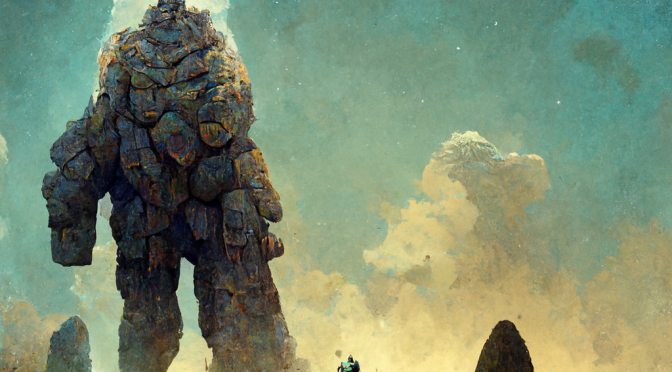
In many cultures, before there were humans, giants roamed the earth. These giants created the spectacular structures dotting the landscape that surely no human could ever have made. In Euskal Herria, there are a couple of these beings that roam the Basque imagination. They come from a time before Christianity and are often defined by their non-Christian origins. The most well known are the Jentilak but there is another group of giants, the Mairu, that built so many of the cromlechs, dolmens, and baserriak of the Basque Country.
An AI-generated conception of a Mairu. Image found on Wikidata.
Mairu, as a word, refers to any non-Christian. Usually, it means people – pagans – of another time and those Mairu are often reflected in the names of megalithic monuments in the Basque Country. Thus, we have Mairubide “road of Mairu” (cromlechs of Oiartzun), Mairuilarri “grave of Mairu” (cromlechs of Zugarramurdi), Mailarreta or Mairuilarrieta “place of cromlechs” (on the Otsondo-Mondarrain mountain), Mairuetxe “house of Mairu” (erected stones from Mount Buluntsa, dolmen of Mendibe and in the region of Okabe), Mairu-arhan “plum of Mairu”, and Mairu-ilhar “pea of Mairu.” The word Mairukeri, again referring to the ancient pagans, means “wild conduct.”
Often, the Mairu are associated with feats of great strength, hence why these massive ancient monuments are named for them. Some giant must have made the dolmens, harrespil, and the sturdiest of baserriak that dot the Basque landscape. They often play the same role in stories as the Jentilak.
However, the term Mairu is not only associated with these ancient pagan giants. It is also used to identify any non-Christian. Anyone not baptized is a Mairu. The arm of a child that is either not baptized or died before baptism is called mairubeso – the arm of mairu. These arms – the bones of the arm – of these non-Christian children play their own role in Basque legend. In some stories, the protagonist uses the mairubeso – the arm bone of the unbaptized child – as a light to navigate the night and sometimes to subdue the inhabitants of the house where such a torch is found lit.
Unbaptized children, Mairu, are buried near the house or garden rather than in the church plots and cemeteries.
The word Mairu often more directly means Moor as well. There is some evidence that other areas of Europe believed that peoples from the south came with the technology to build such massive structures. Thus, the Mairu might originally have been North Africans.
A full list of all of Buber’s Basque Facts of the Week can be found in the Archive.

















.jpg)